
Thousands of Process Automation Professionals to Converge at CamundaCon Live 2021 – StreetInsider.com
Thousands of Process Automation Professionals to Converge at CamundaCon Live 2021 StreetInsider.com
Continue reading »The latest outputs from researchers, alumni and friends at the UCL Centre for Advanced Spatial Analysis (CASA).
Thousands of Process Automation Professionals to Converge at CamundaCon Live 2021 StreetInsider.com
Continue reading »Thousands of Process Automation Professionals to Converge at CamundaCon Live 2021 Business Wire
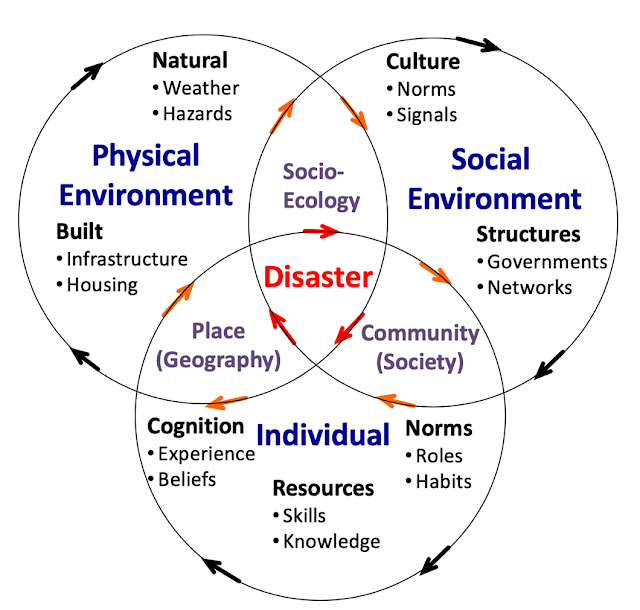
Continue reading »In past posts we have discussed or demonstrated how computational social science (CSS) (i.e. the study of social science through computational methods) and complexity theory can be utilized explore disasters or diseases but this has not really been formalized. To this end, Annetta Burger, William Kennedy and myself have a new review paper in Urban Science entitled “Organizing Theories for Disasters into a Complex Adaptive System Framework.” In the paper we review over a century of disaster research and demonstrate the properties and dynamics of complex adaptive systems in such studies and argue how complexity theory is integral to understanding human behavior in disasters by addressing the interactions across systems (i.e., physical, social, and individual systems). We discuss the characteristics of a complex adaptive system (e.g., heterogeneity, webs of connections, relationships and interactions, and adaptations arising from individual actions, decisions, and learning) and how such characteristics can be applied to disaster research and explore implications for future disaster research with an eye on sustainable and resilient cities. If this sounds of interest, and you want to find out more, below we provide the abstract to the paper and a link to the the paper itself.
Abstract: Increasingly urbanized populations and climate change have shifted the focus of decision1makers from economic growth to the sustainability and resilience of urban infrastructure and communities, especially when communities face multiple hazards and need to recover from recurring disasters. Understanding human behavior and its interactions with built-environments in disasters requires disciplinary crossover to explain its complexity, therefore we apply the lens of complex adaptive systems (CAS) to review disaster studies across disciplines. Disasters can be understood to consist of three interacting systems: 1) the physical system, consisting of geological, ecological, and human-built systems; 2) the social system, consisting of informal and formal human collective behavior; and 3) the individual actor system. Exploration of human behavior in these systems shows that CAS properties of heterogeneity, interacting subsystems, emergence, adaptation, and learning are integral, not just to cities, but to disaster studies and connecting them in the CAS framework provides us with a new lens to study disasters across disciplines. This paper explores the theories and models used in disaster studies, provides a framework to study and explain disasters, and discusses how complex adaptive systems can support theory-building in disaster science for promoting more sustainable and resilient cities.
Keywords: Cities; Complex Adaptive Systems; Computational Social Science, Disasters; Human Behavior.
![]() |
| Framework for Understanding the Intersecting Complex Adaptive Systems of Disaster. |
Full Reference:
Burger, A., Kennedy, W.G. and Crooks A.T. (2021), Organizing Theories for Disasters into a Complex Adaptive System Framework, Urban Science, 5(3), 61; https://doi.org/10.3390/urbansci5030061 (pdf)
Continue reading »
In past posts we have discussed or demonstrated how computational social science (CSS) (i.e. the study of social science through computational methods) and complexity theory can be utilized explore disasters or diseases but this has not really been formalized. To this end, Annetta Burger, William Kennedy and myself have a new review paper in Urban Science entitled “Organizing Theories for Disasters into a Complex Adaptive System Framework.” In the paper we review over a century of disaster research and demonstrate the properties and dynamics of complex adaptive systems in such studies and argue how complexity theory is integral to understanding human behavior in disasters by addressing the interactions across systems (i.e., physical, social, and individual systems). We discuss the characteristics of a complex adaptive system (e.g., heterogeneity, webs of connections, relationships and interactions, and adaptations arising from individual actions, decisions, and learning) and how such characteristics can be applied to disaster research and explore implications for future disaster research with an eye on sustainable and resilient cities. If this sounds of interest, and you want to find out more, below we provide the abstract to the paper and a link to the the paper itself.
Abstract: Increasingly urbanized populations and climate change have shifted the focus of decision1makers from economic growth to the sustainability and resilience of urban infrastructure and communities, especially when communities face multiple hazards and need to recover from recurring disasters. Understanding human behavior and its interactions with built-environments in disasters requires disciplinary crossover to explain its complexity, therefore we apply the lens of complex adaptive systems (CAS) to review disaster studies across disciplines. Disasters can be understood to consist of three interacting systems: 1) the physical system, consisting of geological, ecological, and human-built systems; 2) the social system, consisting of informal and formal human collective behavior; and 3) the individual actor system. Exploration of human behavior in these systems shows that CAS properties of heterogeneity, interacting subsystems, emergence, adaptation, and learning are integral, not just to cities, but to disaster studies and connecting them in the CAS framework provides us with a new lens to study disasters across disciplines. This paper explores the theories and models used in disaster studies, provides a framework to study and explain disasters, and discusses how complex adaptive systems can support theory-building in disaster science for promoting more sustainable and resilient cities.
Keywords: Cities; Complex Adaptive Systems; Computational Social Science, Disasters; Human Behavior.
![]() |
| Framework for Understanding the Intersecting Complex Adaptive Systems of Disaster. |
Full Reference:
Burger, A., Kennedy, W.G. and Crooks A.T. (2021), Organizing Theories for Disasters into a Complex Adaptive System Framework, Urban Science, 5(3), 61; https://doi.org/10.3390/urbansci5030061 (pdf)
Continue reading »

After nearly a year and a half when much of London has been staying away from its central business district, there’s a big push to get people back into the middle of town. The Mayor of London and Visit London have this week launched Let’s D…
Continue reading »While agent-based modeling is growing within many areas (e.g., geography, ecology) one area that has not seen many applications is that of social work. For example how can we explore what may cause an increase or a decrease in delinquency and recidivis…
Continue reading »James Cheshire, UCL and Alex Singleton, University of Liverpool As England emerged from its second national lockdown in early December, Boris Johnson, the UK prime minister, faced an onslaught of questions from MPs on both sides of the House of Commons. Each demanded clarity on what the arrangements would be for their particular constituency under…
The post How England’s complicated political geography is confusing coronavirus rules appeared first on James Cheshire.
Continue reading »Time to find some painted lions in central London! The Tusk London Trail is a series of life-size fibreglass lions, painted by a variety of artists and comedians including Lee Mack (“Three Shirts on the Lion”) and Noel Fielding, as well as …
Continue reading »Almost a year ago, I heard the term DevRel for the first time when Sara Safavi, from Planet, gave a talk at CodeOp and used that word to describe her new role. I knew Sara as a developer, like myself, … Continue reading →
Continue reading »Almost a year ago, I heard the term DevRel for the first time when Sara Safavi, from Planet gave a talk at CodeOp and use that word to describe her knew role. I knew Sara as a developer, like myself, … Continue reading →
Continue reading »Really excited to announce that Atlas of the Invisible, the third book I have co-authored with Oliver Uberti will be in bookshops soon! You can pre-order it here!
The post Atlas of the Invisible appeared first on James Cheshire.
Come work with me!The Department of Geography at the University at Buffalo (UB) invites applicants for a postdoctoral researcher position with broad interests in urban analytics with a particular emphasis on modeling and simulation. The postdoc…
Continue reading »Come work with me!The Department of Geography at the University at Buffalo (UB) invites applicants for a postdoctoral researcher position with broad interests in urban analytics with a particular emphasis on modeling and simulation. The postdoc…
Continue reading »In our latest blog, Nicholas Allo, CEO at The Visual Earth Group, shares thoughts on whether and how release of Census 2021 data may provide opportunities for detections and interventions in reverse gentrification. Every ten years, the Office of National Statistics (ONS) redoes its count of the British populace during a census. During this exercise, … More Census 2021 and reverse gentrification in collection areas: early detection and intervention
Continue reading »Read here to find out more about the 2021 Joanna Stillwell prize winner for best UK undergraduate dissertation in Population Geography. … More A prize winning dissertation!
Continue reading »Building on our work on synthetic populations, Na (Richard) Jiang, Bill Kennedy, Hamdi Kavak, and myself have a new paper which was presented at the 2021 Annual Modeling and Simulation (ANNSIM) Conference entitled “Generation of Reusable Synthetic Popu…
Continue reading »Mathematician Hannah Fry: ‘I’m sure there’s lots of tutting — but not to my face’ Financial Times
Continue reading »Mathematician Hannah Fry: ‘I’m sure there’s lots of tutting — but not … Financial Times
Continue reading »Knowledge exchange project explores virtual reality in museums Mirage News
Continue reading »In the past we had posted on models of radicalization, but such models were rather abstract. However in a recent paper entitled “Kinetic Action and Radicalization: A Case Study of Pakistan” which was presented at the International Conferenc…
Continue reading »England’s Wider Than Ever Cars Parked 23 Hours A Day, Finds Motoring Body Forbes
Continue reading »City of the future: away the cars if they want to survive | Near future FuturoProssimo
Continue reading »Running large scale spatial agent-based models is often a computational challenge. To address this challenge, at the upcoming International Conference on Social Computing, Behavioral-Cultural Modeling and Prediction and Behavior Representation in Mode…
Continue reading »Cities “must become car-free to survive” About Manchester
Continue reading »When Graphs Are a Matter of Life and Death The New Yorker
Continue reading »The lovely people at the KooZA/rch platform have published an interview with me, on the theme of the ‘deactivated city’: how COVID-19 has altered urban form and processes, and how far these changes might stick around.They’ve also added some superb phot…
Continue reading »When Graphs Are a Matter of Life and Death The New Yorker
Continue reading »Incubators, accelerators and urban economic developmentI’ve got a new paper on incubators, accelerators and cities out in Urban Studies. It’s written with Margarida Madaleno, Henry Overman and Sevrin Waights.Why should you read it? I think there’s four…
Continue reading »Posted here because I will inevitably forget this painfully worked-out answer for having legends for two different types of plots in Seaborn… import numpy as np import pandas as pd import seaborn as sns import matplotlib.pyplot as plt # We ……
Continue reading »Inference and influence of network structure using snapshot social behavior without network data Science Advances
Continue reading »EYFS Best Practice – All about… pandemic play Nursery World
Continue reading »