Welcome to DataShine!
Last October I was fortunate enough to be awarded an ES […]
Continue reading »The latest outputs from researchers, alumni and friends at the UCL Centre for Advanced Spatial Analysis (CASA).

Last October I was fortunate enough to be awarded an ES […]
Continue reading »Last October I was fortunate enough to be awarded an ES […]
Continue reading »This map shows the proportion of people that consider themselves to be in very good health, in the Liverpool and Wirral area. By using a diverging colour scheme, it shows there are stark differences between the two sides of the River Mersey, and within Liverpool itself – even within the city centre area.
Continue reading »DataShine: Census uses ColorBrewer for its colours ramps. There are six ramps provided by default, which can be selected at the bottom of the website – five sequential ones and one diverging one, which is used for many maps where the standard deviation on the percentage population is a lot lower than the population percentage […]
Continue reading »The ornament is returning slowly to the architectural discourse. It has not really been absent though merely denied, but it is returning as a more prominent topic now. A key text is Adolf Loos’ Ornament and crime (Ornament und Verbrechen) (1908) that…
Continue reading »
The ornament is returning slowly to the architectural discourse. It has not really been absent though merely denied, but it is returning as a more prominent topic now.
A key text is Adolf Loos’ Ornament and crime (Ornament und Verbrechen) (1908) that was widely interpreted as at the easement of ornament in architecture. More recent interpretations (for example Gleiter, 2012) however is more differentiated. Already the title in which Loos uses and hints at this. Nevertheless ornament was denied a role in modernist architecture and is still a minefield for architects today.
 Image taken from designboom / A proposed project spelling out the letters ‘BE’ for buildings in Brussels by JDS in 2007.
The way for the reintroduction of ornament has been paved by technology interestingly enough. In the late 80ies and especially the 90ies CAD tools have presented the tools to begin to design with patterns including options to manipulate the pattern based on conditions. This has also the been linked to production and printed glass or pierce metals facades or even brickwork layer by robots (Bearth & Deplazes with Gramazio & Kohler, 2006).
This has been accompanied by theoretical writings, exhibitions and journals. For examples the exhibition at the SAM Re-Sampling Ornament in 2008. The architecture journals ARCH+ (1995/2002), l’architecture d’aujourd’hui (2001) or AD primers, Ornament: the politics of architecture and subjectivity (2013) for example have published on ornament during this early phase. Authors who have contributed to the now re-emerging discussion on ornament include Jörg H. Gleiter ((orig. German, 2002. Die Rückkehr des Verdrängten)), Michael Dürfeld (The Ornament and the Architectural Form (orig. in German, 2008. Das Ornamentale und die architektonische Form)) or Farshid Moussavi (The Function of Form, 2008).
The new possibilities in design and production using new technologies have allowed to re-imagine the relationship between design, production and product. Whereas at the time Loos wrote Architecture and Crime the industrialisation introduced the production of exact replicas into the thousands of one single product, the new technologies based around computers allow for a trance dent workflow and individually adapted and styled objects whilst still machine and mass produced. Hence the conditions have fundamentally changed.
What can be observed is, though very slow moving, a shift from an understanding of ornament as decoration to an interpretation of ornament as process in the sense of structure and narrative.
A special take on this is presented by Michiel van Raaij in his new publication Building as Ornament. Whilst van Raaij focuses on iconographic architecture he proposes building as ornament as a term to frame part of this discussion in a new way implying links to a theoretical discussion with references to a long tradition.
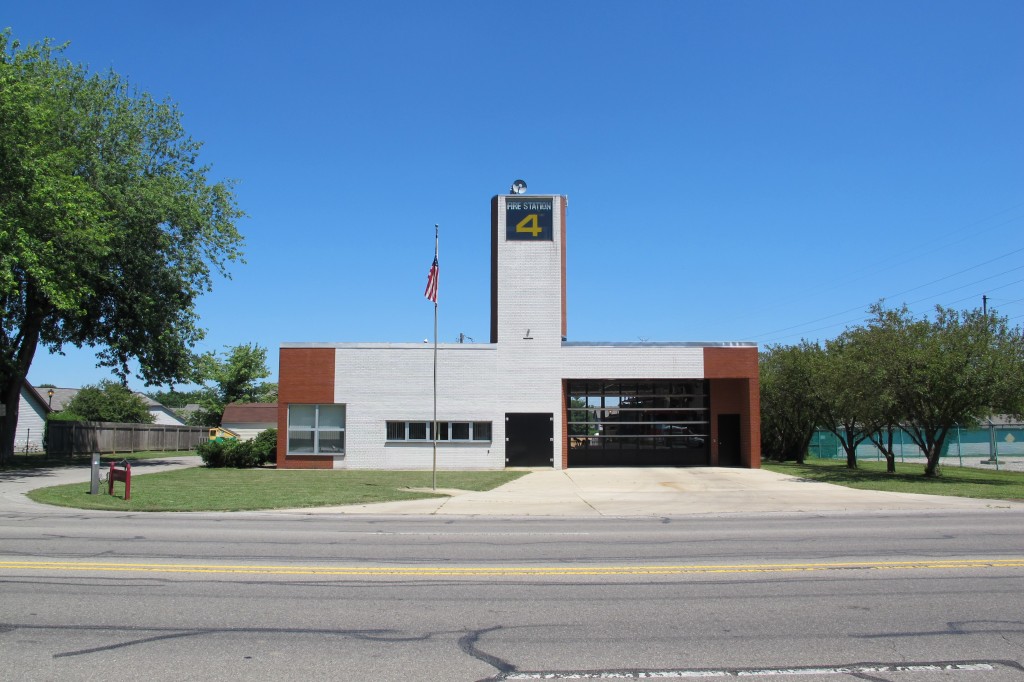 Image taken from 52weeks / The Fire Station 4 in Columbus by Venturi Scott Brown and Associates in 1968.
Van Raaij’s idea is to try and focus on the story the architect tries to tell through an iconic building. He argues that “Iconography is the use of images from outside architecture in architecture” and that the focus of the book is on “iconography that explains the function, social status, organisation, load-bearing structure and/or context of the building”. He makes the link to ornament using the narrative in the sense of explaining something.
The book brings together over 100 examples to illustrate this notion. This ranges from the Yokohama International Port Perminal by FOA, 2004, to the Bird’s Nest Stadium by Herzog de Meuron in 2008 or the People’s Building in Shanghai by BIG, 2004.
Whilst the book does not offer a theoretical framework for the introduced terminology or a broader discussion on the theoretical dimension of such a ‘new’ aspect of ornament in architecture, it presents a conversation. The publication is on one had a collection of projects that fit the description iconographic architecture and it is on the other hand a collection of interviews in which the author van Raaij discusses iconographic architecture with architects and architectural historians.
 Image taken from architecture.com / The Signal Box in Basel, Switzerland by Herzog de Meuron in 1994.
The interview partners are, in order of appearance: Auke van der Would, Charles Jencks, Denise Scott Brown, Adriaan Geuze, Michiel Riedijk, Alejandro Zaero-Polo, Ben van Berkel, Steven Holl, Winy Maas and Bjarke Ingels.
All of the interview partners of course have a different angle on the topic and in some conversations the focus is more on icons, narratives, construction or material. Some do specifically discuss ornament as in the recently emerging debate, so for examples the interview with Denise Scott Brown where she discusses aspects of the design for Fire Station 4 in Columbus. She emphasises the very same topics of structure and narrative the ornament discussion is moving towards. Other interviews do however not even touch ornament.
There is loads of material and a very interesting discussion around icons in architecture and iconographic architecture to be found in this book. This is clearly the focus of van Raaij’s work and his personal interest. He has been running a blog on iconic buildings for a long time and he knows the projects in this field. The real contribution of this book is definitely to hear the architects, as described by van Raaij as the Generation OMA, to talk about icons and iconographic design processes in architecture. There are some very personal statements in these discussions that shed light on some of the famous icons this current generation of architects have developed. It demonstrates that there is more to the discussion of iconic architecture than it just being a land mark put up by an architect to make a bold statement.
Through out the book the terms ornament and icon/iconographic architecture are used interchangeably. And it turns out that ornament only plays a small role setting the stage in this nai010 publishers book. Even though one could have expected quite some potential in this take on ornaments, not as a complete explanation, but as a special case of ornament on the level of the building. More contextual material would be needed to define a clear standpoint.
However, the chosen title, it has to be said, is very cleverly chosen. It is catchy, provides a lot of historical context, touches the nerve (both of time and architects still hating ornaments, as they have been told to do in architecture school?) and it is simple enough to be self-explanatory whilst allowing room for imagination. Nevertheless for the reader who is looking for the specific topic on ornament it might mean to be disappointed, but not without discovering an interesting collection of personal discussions on iconic architecture.
 Image taken from designboom / Book cover.
Van Raaij, M., 2014. Building as Ornament. nai010 publishers, Rotterdam.

The ornament is returning slowly to the architectural discourse. It has not really been absent though merely denied, but it is returning as a more prominent topic now.
A key text is Adolf Loos’ Ornament and crime (Ornament und Verbrechen) (1908) that was widely interpreted as at the easement of ornament in architecture. More recent interpretations (for example Gleiter, 2012) however is more differentiated. Already the title in which Loos uses and hints at this. Nevertheless ornament was denied a role in modernist architecture and is still a minefield for architects today.
Image taken from designboom / A proposed project spelling out the letters ‘BE’ for buildings in Brussels by JDS in 2007.
The way for the reintroduction of ornament has been paved by technology interestingly enough. In the late 80ies and especially the 90ies CAD tools have presented the tools to begin to design with patterns including options to manipulate the pattern based on conditions. This has also the been linked to production and printed glass or pierce metals facades or even brickwork layer by robots (Bearth & Deplazes with Gramazio & Kohler, 2006).
This has been accompanied by theoretical writings, exhibitions and journals. For examples the exhibition at the SAM Re-Sampling Ornament in 2008. The architecture journals ARCH+ (1995/2002), l’architecture d’aujourd’hui (2001) or AD primers, Ornament: the politics of architecture and subjectivity (2013) for example have published on ornament during this early phase. Authors who have contributed to the now re-emerging discussion on ornament include Jörg H. Gleiter ((orig. German, 2002. Die Rückkehr des Verdrängten)), Michael Dürfeld (The Ornament and the Architectural Form (orig. in German, 2008. Das Ornamentale und die architektonische Form)) or Farshid Moussavi (The Function of Form, 2008).
The new possibilities in design and production using new technologies have allowed to re-imagine the relationship between design, production and product. Whereas at the time Loos wrote Architecture and Crime the industrialisation introduced the production of exact replicas into the thousands of one single product, the new technologies based around computers allow for a trance dent workflow and individually adapted and styled objects whilst still machine and mass produced. Hence the conditions have fundamentally changed.
What can be observed is, though very slow moving, a shift from an understanding of ornament as decoration to an interpretation of ornament as process in the sense of structure and narrative.
A special take on this is presented by Michiel van Raaij in his new publication Building as Ornament. Whilst van Raaij focuses on iconographic architecture he proposes building as ornament as a term to frame part of this discussion in a new way implying links to a theoretical discussion with references to a long tradition.
Image taken from 52weeks / The Fire Station 4 in Columbus by Venturi Scott Brown and Associates in 1968.
Van Raaij’s idea is to try and focus on the story the architect tries to tell through an iconic building. He argues that “Iconography is the use of images from outside architecture in architecture” and that the focus of the book is on “iconography that explains the function, social status, organisation, load-bearing structure and/or context of the building”. He makes the link to ornament using the narrative in the sense of explaining something.
The book brings together over 100 examples to illustrate this notion. This ranges from the Yokohama International Port Perminal by FOA, 2004, to the Bird’s Nest Stadium by Herzog de Meuron in 2008 or the People’s Building in Shanghai by BIG, 2004.
Whilst the book does not offer a theoretical framework for the introduced terminology or a broader discussion on the theoretical dimension of such a ‘new’ aspect of ornament in architecture, it presents a conversation. The publication is on one had a collection of projects that fit the description iconographic architecture and it is on the other hand a collection of interviews in which the author van Raaij discusses iconographic architecture with architects and architectural historians.
Image taken from architecture.com / The Signal Box in Basel, Switzerland by Herzog de Meuron in 1994.
The interview partners are, in order of appearance: Auke van der Would, Charles Jencks, Denise Scott Brown, Adriaan Geuze, Michiel Riedijk, Alejandro Zaero-Polo, Ben van Berkel, Steven Holl, Winy Maas and Bjarke Ingels.
All of the interview partners of course have a different angle on the topic and in some conversations the focus is more on icons, narratives, construction or material. Some do specifically discuss ornament as in the recently emerging debate, so for examples the interview with Denise Scott Brown where she discusses aspects of the design for Fire Station 4 in Columbus. She emphasises the very same topics of structure and narrative the ornament discussion is moving towards. Other interviews do however not even touch ornament.
There is loads of material and a very interesting discussion around icons in architecture and iconographic architecture to be found in this book. This is clearly the focus of van Raaij’s work and his personal interest. He has been running a blog on iconic buildings for a long time and he knows the projects in this field. The real contribution of this book is definitely to hear the architects, as described by van Raaij as the Generation OMA, to talk about icons and iconographic design processes in architecture. There are some very personal statements in these discussions that shed light on some of the famous icons this current generation of architects have developed. It demonstrates that there is more to the discussion of iconic architecture than it just being a land mark put up by an architect to make a bold statement.
Through out the book the terms ornament and icon/iconographic architecture are used interchangeably. And it turns out that ornament only plays a small role setting the stage in this nai010 publishers book. Even though one could have expected quite some potential in this take on ornaments, not as a complete explanation, but as a special case of ornament on the level of the building. More contextual material would be needed to define a clear standpoint.
However, the chosen title, it has to be said, is very cleverly chosen. It is catchy, provides a lot of historical context, touches the nerve (both of time and architects still hating ornaments, as they have been told to do in architecture school?) and it is simple enough to be self-explanatory whilst allowing room for imagination. Nevertheless for the reader who is looking for the specific topic on ornament it might mean to be disappointed, but not without discovering an interesting collection of personal discussions on iconic architecture.
Image taken from designboom / Book cover.
Van Raaij, M., 2014. Building as Ornament. nai010 publishers, Rotterdam.
Continue reading »
The ornament is returning slowly to the architectural discourse. It has not really been absent though merely denied, but it is returning as a more prominent topic now.
A key text is Adolf Loos’ Ornament and crime (Ornament und Verbrechen) (1908) that was widely interpreted as at the easement of ornament in architecture. More recent interpretations (for example Gleiter, 2012) however is more differentiated. Already the title in which Loos uses and hints at this. Nevertheless ornament was denied a role in modernist architecture and is still a minefield for architects today.
Image taken from designboom / A proposed project spelling out the letters ‘BE’ for buildings in Brussels by JDS in 2007.
The way for the reintroduction of ornament has been paved by technology interestingly enough. In the late 80ies and especially the 90ies CAD tools have presented the tools to begin to design with patterns including options to manipulate the pattern based on conditions. This has also the been linked to production and printed glass or pierce metals facades or even brickwork layer by robots (Bearth & Deplazes with Gramazio & Kohler, 2006).
This has been accompanied by theoretical writings, exhibitions and journals. For examples the exhibition at the SAM Re-Sampling Ornament in 2008. The architecture journals ARCH+ (1995/2002), l’architecture d’aujourd’hui (2001) or AD primers, Ornament: the politics of architecture and subjectivity (2013) for example have published on ornament during this early phase. Authors who have contributed to the now re-emerging discussion on ornament include Jörg H. Gleiter ((orig. German, 2002. Die Rückkehr des Verdrängten)), Michael Dürfeld (The Ornament and the Architectural Form (orig. in German, 2008. Das Ornamentale und die architektonische Form)) or Farshid Moussavi (The Function of Form, 2008).
The new possibilities in design and production using new technologies have allowed to re-imagine the relationship between design, production and product. Whereas at the time Loos wrote Architecture and Crime the industrialisation introduced the production of exact replicas into the thousands of one single product, the new technologies based around computers allow for a trance dent workflow and individually adapted and styled objects whilst still machine and mass produced. Hence the conditions have fundamentally changed.
What can be observed is, though very slow moving, a shift from an understanding of ornament as decoration to an interpretation of ornament as process in the sense of structure and narrative.
A special take on this is presented by Michiel van Raaij in his new publication Building as Ornament. Whilst van Raaij focuses on iconographic architecture he proposes building as ornament as a term to frame part of this discussion in a new way implying links to a theoretical discussion with references to a long tradition.
Image taken from 52weeks / The Fire Station 4 in Columbus by Venturi Scott Brown and Associates in 1968.
Van Raaij’s idea is to try and focus on the story the architect tries to tell through an iconic building. He argues that “Iconography is the use of images from outside architecture in architecture” and that the focus of the book is on “iconography that explains the function, social status, organisation, load-bearing structure and/or context of the building”. He makes the link to ornament using the narrative in the sense of explaining something.
The book brings together over 100 examples to illustrate this notion. This ranges from the Yokohama International Port Perminal by FOA, 2004, to the Bird’s Nest Stadium by Herzog de Meuron in 2008 or the People’s Building in Shanghai by BIG, 2004.
Whilst the book does not offer a theoretical framework for the introduced terminology or a broader discussion on the theoretical dimension of such a ‘new’ aspect of ornament in architecture, it presents a conversation. The publication is on one had a collection of projects that fit the description iconographic architecture and it is on the other hand a collection of interviews in which the author van Raaij discusses iconographic architecture with architects and architectural historians.
Image taken from architecture.com / The Signal Box in Basel, Switzerland by Herzog de Meuron in 1994.
The interview partners are, in order of appearance: Auke van der Would, Charles Jencks, Denise Scott Brown, Adriaan Geuze, Michiel Riedijk, Alejandro Zaero-Polo, Ben van Berkel, Steven Holl, Winy Maas and Bjarke Ingels.
All of the interview partners of course have a different angle on the topic and in some conversations the focus is more on icons, narratives, construction or material. Some do specifically discuss ornament as in the recently emerging debate, so for examples the interview with Denise Scott Brown where she discusses aspects of the design for Fire Station 4 in Columbus. She emphasises the very same topics of structure and narrative the ornament discussion is moving towards. Other interviews do however not even touch ornament.
There is loads of material and a very interesting discussion around icons in architecture and iconographic architecture to be found in this book. This is clearly the focus of van Raaij’s work and his personal interest. He has been running a blog on iconic buildings for a long time and he knows the projects in this field. The real contribution of this book is definitely to hear the architects, as described by van Raaij as the Generation OMA, to talk about icons and iconographic design processes in architecture. There are some very personal statements in these discussions that shed light on some of the famous icons this current generation of architects have developed. It demonstrates that there is more to the discussion of iconic architecture than it just being a land mark put up by an architect to make a bold statement.
Through out the book the terms ornament and icon/iconographic architecture are used interchangeably. And it turns out that ornament only plays a small role setting the stage in this nai010 publishers book. Even though one could have expected quite some potential in this take on ornaments, not as a complete explanation, but as a special case of ornament on the level of the building. More contextual material would be needed to define a clear standpoint.
However, the chosen title, it has to be said, is very cleverly chosen. It is catchy, provides a lot of historical context, touches the nerve (both of time and architects still hating ornaments, as they have been told to do in architecture school?) and it is simple enough to be self-explanatory whilst allowing room for imagination. Nevertheless for the reader who is looking for the specific topic on ornament it might mean to be disappointed, but not without discovering an interesting collection of personal discussions on iconic architecture.
Image taken from designboom / Book cover.
Van Raaij, M., 2014. Building as Ornament. nai010 publishers, Rotterdam.

The south-west is known as a place where there are many second homes. In some villages, so many of the homes are empty for much of the year, or are simply holiday homes, that living there can seem even quieter than you would expect. Above is Newquay, the capital of surfing in the south-west and […]
Continue reading »
Cycling to work is on the increase but is at very low levels in most places in the UK – and there are very wide variations, even across towns and cities of similar size. Bristol (above) and London both see zones of high usage – typically in inner city suburbs popular with students and graduates: […]
Continue reading »
London is a significant destination for many people at various lifestages. One particularly popular inflow is university graduates looking for a place to live as they start their first career-minded job in the capital – coming from the other 100 or so universities in the UK outside London, or from Europe or elsewhere. It is […]
Continue reading »I first met Leo Kadanoff in Cambridge, England in the summer of 1974, I think. He would not remember me but he had been invited to give a talk on urban dynamics at the second Cambridge Land Use and Built … Continue reading →
Continue reading »London has many networks – roads, tube trains, el […]
Continue reading »I’m apparently now in the Sustainability field (which is rather exciting): the first paper with my name on it was published in Sustainability: The Journal of Record this month. Anthropologist Charlotte Johnson is first author (I’m the second, and final, author), … Continue reading →
I’m apparently now in the Sustainability field (which is rather exciting): the first paper with my name on it was published in Sustainability: The Journal of Record this month. Anthropologist Charlotte Johnson is first author (I’m the second, and final, author), … Continue reading →
About a month ago, Francois Grey put out a suggestion that we should replace the term ‘bottom-up’ science with upscience – do read his blog-post for a fuller explanation. I have met Francois in New York in April, when he discussed with me the ideas behind the concept, and why it is worth trying to use it. […]

Anyone who’s done any work in the vicinity of network science or, more specifically, seen social scientists attempting network science, will have seen plenty of images such as this: Taken from Fagiolo and Mastrorillo (2013) or this: Taken from Adamic and Glance (2005) which add little scientific input, but merely dazzle the reader with the […]
Continue reading »
We recently contributed a chapter to Geocomputation (2nd edition) entitled “The Evolving GeoWeb”. What is interesting is the marked difference between the first edition (which was published in 2000) and the second. For example, in the latest edition, t…
Continue reading »
We recently contributed a chapter to Geocomputation (2nd edition) entitled “The Evolving GeoWeb”. What is interesting is the marked difference between the first edition (which was published in 2000) and the second. For example, in the latest edition, t…
Continue reading »A talk given at the Oxford Institute for Population and Ageing, University of Oxford 4/6/14.
Continue reading »Disabled Freedom Pass Card journeys on the London Underground from Gareth Simons on Vimeo.
This…
Continue reading »Disabled Freedom Pass Card journeys on the London Underground from Gareth Simons on Vimeo.
This…
Continue reading »Disabled Freedom Pass Card journeys on the London Underground from Gareth Simons on Vimeo.
This…
Continue reading »Disabled Freedom Pass Card journeys on the London Underground from Gareth Simons on Vimeo.
This…
Continue reading »‘More or Less‘ is a good programme on BBC Radio 4. Regularly exploring the numbers and the evidence behind news stories and other important things, and checking if they stand out. However, the piece that was broadcast this week about Golf courses and housing in the UK provides a nice demonstration of when not to […]
|
London’s Boring Conference: eggs, ice cream van chimes and pothole gardens
The Voice of Russia This year’s speakers at the Boring Conference include Martin Zaltz Austwick talking about eggs. He is an academic, musician and occasional visual artist. In real life, he works at the Bartlett Centre for Advanced Spatial Analysis at University College … |
|
How Canada’s Smart Cities Can Reach Their Full Potential
Techvibes (blog) Dr. Ed Manley from the UCL Centre for Advanced Spatial Analysis-CASA, Nicolas Dinh, Vice President of Mobile Payments at MasterCard Canada and Kristina Verner, Waterfront Toronto’s Director of Intelligent Communities shared their insights on what is … |
If you follow UK statistics you might know the Office of National Statistics has been developing a new set of geographies for reporting workplace-focused data from the 2011 Census, called Workplace Zones. The zones have been developed (following a pilot by the University of Southampton) using the existing census Output Areas as a starting point, but […]
Continue reading »|
Com’è cresciuta Londra negli ultimi 2000 anni
Il Post Il video mostra l’evoluzione urbanistica di Londra dai tempi dei Romani al 2013, è stato realizzato dal Bartlett Centre for Advanced Spatial Analysis, ed è stato ideato e diretto da Polly Hudson. I dati che raccontano lo sviluppo della città sono … |
Originally posted on GIS and Science:
“Citizen science is scientific research conducted, in whole or in part, by amateur or nonprofessional scientists, often by crowdsourcing and crowdfunding.” –Wikipedia Applications of geospatial technologies have already proven themselves invaluable for scientific research and understanding. But is there an opportunity for citizen scientists to leverage geospatial technologies in…

Lewisham’s “data” I’ve been looking at a lot of London Borough council websites recently, for the Election Map. I’d rather I hadn’t – just one website would be better – but in London, each borough council publishes its local election results first and foremost to its own website, rather than it being pushed to a […]
Continue reading »What can plants reveal about gene flow? That it’s an important evolutionary force Phys.OrgA plant breeder discovers his experimental crops have been “contaminated” with genes from a neighboring field. New nasty weeds sometimes evolve directl…
Continue reading »
This last semester, I taught a class entitled “Spatial Agent-based Models of Human-Environment Interactions” which introduces graduate students to the use of agent-based techniques as a means of modelling human-environmental interactions. Within the cl…
Continue reading »
This last semester, I taught a class entitled “Spatial Agent-based Models of Human-Environment Interactions” which introduces graduate students to the use of agent-based techniques as a means of modelling human-environmental interactions. Within the cl…
Continue reading »The above graph shows the results of the council electi […]
Continue reading »
Here is the new political colour of London for 2014, following the local council elections last week. Rather than applying a simple colour to each of the 32 boroughs as most election maps do, I have instead represented all the 628 wards, across the boroughs, as a coloured circle. The map shows votes, not results. […]
Continue reading »Here is a short list of some awesome narrative based webpages using d3.js and other javascript techniques to enhance narrative-based information. The list was compiled by Matthew French at newsdesigns.com, but I reproduce it here an hope to extend. http://www.theglobeandmail.com/news/national/the-north/the-magnetic-north/article16364070/ http://www.nytimes.com/newsgraphics/2013/10/13/russia/ http://www.nytimes.com/newsgraphics/2013/10/27/south-china-sea/ http://www.nytimes.com/projects/2012/snow-fall/#/?part=tunnel-creek http://newsinteractive.post-gazette.com/gettysburg/ http://www.nytimes.com/projects/2013/tomato-can-blues/ http://www.nytimes.com/interactive/2014/02/11/sports/sochi-2014-interactive-stories.html
Continue reading »Talk given at National Centre for Geocomputation: Home – NUI Maynooth 21/5/14.
Continue reading »40 years ago, Douglass B Lee published his notorious article “Requiem for Large Scale Models” in the Journal of the American Institute of Planners on the demise of the first generation of urban computer models in the United States. In … Continue reading →
Continue reading »Video: Fascinating animation which shows the evolution of LondonBelfast TelegraphThe LEA was developed by The Bartlett Centre for Advanced Spatial Analysis (UCL), as a partnership project between English Heritage, Dr Kiril Stanilov -The Centre for Smar…
Continue reading »