Latest Posts

Invisible fields

The Washington Post recently released a front-page article claiming that “The federal government wants to create super WiFi networks across the nation…Cities support the idea because the networks would lower costs for schools and businesses or help vacationers easily find tourist spots. Consumer advocates note the benefits to the poor, who often cannot afford high cellphone and Internet bills.”
I will not comment on whether this is a true or false statement, however I am at the CASA office in Tottenham court road and right now i am probably within the range of more than 100 sending and receiving signals. From mobile phones, to wireless networks, to the Geiger counter which measures radiation levels and shows results real-time via CASA’s online webpage “CityDashboard”. Sensors have come to realize a new urban landscape. A new locality which is not however making a realized dialogue with the physical environment… However, there are side-effects.

Wireless in the world from Timo on Vimeo.

“This new urban landscape is no longer predicated solely on architecture and urbanism. These disciplines now embrace emerging methodologies that bend the physical with new measures, representations and maps of urban dynamics such as traffic or mobile phone flows. Representations of usage patterns and mapping the life of the city amplify our collective awareness of the urban environment as a living organism. These soft and invisible architectures fashion sentient and reactive environments.”(1)
In that sense, Urban transformations may not result merely from “changing economic and social drivers within and around densely populated areas” (2), but from a more abstract distortion of time and space. Utopian Architects and planners predicted from a very early age that future cities would not only be defined by buildings and streets, but also by different flows of information. It is now widely accepted that citizens would have to live in a constant flux and there is a need for identifying the possible effects of these new systems, as they are potentially new constituencies for the development of planning.
The introduction of open real-time data may aid in the development of new scenarios and a hint that we are leading in this direction is the recent interest in crowdourcing data analysis and visualizations e.g. the Twitter API which is one of the most popular APIs for visualizations. There are now over 50 Twitter visualizations. “These applications mine Tweets to provide services that help users track topics of interest, geolocated Tweets and are even used to predict flu outbreaks”.(2)


The globe tweeter visualizes real-time twits on a 3D globe project by Cedric Pinson (code development), Design by Guillaume Lecollinet, Node.js hacking Johan Euprhosine.

We are officially living in hybrid environments where space and flowing data interact with each other. At the same time, the ways in which we perceive this information plays an important role on our understanding about the environment we live in and therefore affects decision making. The realization of such an era is certainly important for the development of new solutions.
Speaking about invisible fields, Stefan Berke and Martin Hunniger thought of sound as Anthony DeVincenzi (invisible forces) thought of fields. This is a project were midi notes drive the creation of an openGL shader, seeking new aspects in the 3d visualization of invisible fields.

Downtrib, screened at Fulldome UK 2012.

Continue reading »

Job – Research Fellow/Statistician in the Scottish Longitudinal Studies

TweetResearch Fellow/Statistician in the Scottish Longitudinal Studies – ML1290 Description School of Geography & Geosciences, £30,424 – £33,230 per annum, Fixed Term: 12 months, Start: As soon as possible   Details We are seeking a motivated researcher with good statistical and quantitative research skills to work on an ESRC funded research project “Synthetic Data Estimation […]

Continue reading »

2011 Census Open Atlas Project

This month has seen the release of the 2011  census data for England and Wales at Output Area Level. This offers the possibility to map various attributes about people and places for very small geographic areas. Output Areas represent the most detailed geography for which Census data are released and are the building blocks for […]

Continue reading »

2011 Census Open Atlas Project

CensusAtlasThis month has seen the release of the 2011  census data for England and Wales at Output Area Level.

This offers the possibility to map various attributes about people and places for very small geographic areas. Output Areas represent the most detailed geography for which Census data are released and are the building blocks for many popular products such as geodemographic classifications.

Because the data and boundaries are available under an open government licence, and that these data have been usefully placed online as direct downloads (data, boundaries), it makes it  possible to create maps for England and Wales in a highly automated way.

As such, since launch of the Output Area level data I have been busy writing (and then running – around 4 days!) a set of R code that would map every Key Statistics variable for all local authority districts. The code for doing this is fully reproducible, and I have dropped this on my Rpubs blog.

THERE IS A NEW VERSION OF THE ATLAS AVAILABLE HERE

I have generated a PDF atlas for each local authority district, for example:

IF YOU THINK ANY OF THE INFORMATION I HAVE CREATED IS USEFUL, INTERESTING OR OF VALUE, THEN PLEASE  READ THIS BLOG POST AND HELP PROTECT THE NEXT CENSUS!

Why have I created these atlases?

  1. To demonstrate the value of the 2011 census
  2. Provide a free 2011 static Census atlas to anyone who wants one
  3. Because I do not believe web maps should necessarily be the default way of distributing geographic data
  4. To illustrate how open data and software can be used in creative ways to generate insight
  5. An attempt to save local authorities money who might be thinking of doing these type of analyses themselves
  6. To provide reproducible code that enable others to generate similar maps at Output Area level
  7. For fun!
  8. Because R is awesome!
  9. Because R really is awesome!

What is in each atlas?

Each atlas contains a series of vector PDF maps for each Key Statistics variable. The following is a map from the Liverpool Atlas and shows the percentage of “White: English/Welsh/Scottish/Northern Irish/British” for each Output Area in Liverpool.
white

About the data and maps

Almost every non count variable (apart from Hectares) was mapped from the  Key Statistics data disseminated by Nomis, and are either percentage scores or some type of ratio / average. Maps were excluded where there were only a few scores within a local authority district – you can see further explanation of this on the Rpubs page accompanying the analysis. A couple of further points…

  • The variables mapped were based on the calculations that were part of the Nomis data.
  • I have always been a fan of blue choropleth maps which was why the particular colour scheme was chosen.
  • The cartography was automated for all the maps – this means it is more successful for some local authority districts than in others. Some issues I have noted;
  • Those local authorities with many wards appear a little busy with labels (e.g. Cornwall)
  • Cardiff  appears to have a rogue polygon which may be issue with the OA to higher geography lookup table. I will investigate this in a future release…. [Power of the crowd reveals that this is in fact Flat Holm island – thanks to @geospacedman]
  • It would be nice to add scale bars and north arrows to the maps, however, this was proving to be problematic when outputting to PDF. Again, I will try and fix this in a future release.
  • The boundaries used are the generalised files to increase mapping speed and reduce file size – these could be supplemented for the full resolution boundaries in the future
  • These maps are without guarantee or warranty / feel free to fix my code!

View the maps

All maps are available after clicking the post title….

Continue reading »

2011 Census Open Atlas Project

CensusAtlasThis month has seen the release of the 2011  census data for England and Wales at Output Area Level.

This offers the possibility to map various attributes about people and places for very small geographic areas. Output Areas represent the most detailed geography for which Census data are released and are the building blocks for many popular products such as geodemographic classifications.

Because the data and boundaries are available under an open government licence, and that these data have been usefully placed online as direct downloads (data, boundaries), it makes it  possible to create maps for England and Wales in a highly automated way.

As such, since launch of the Output Area level data I have been busy writing (and then running – around 4 days!) a set of R code that would map every Key Statistics variable for all local authority districts. The code for doing this is fully reproducible, and I have dropped this on my Rpubs blog.

THERE IS A NEW VERSION OF THE ATLAS AVAILABLE HERE

I have generated a PDF atlas for each local authority district, for example:

IF YOU THINK ANY OF THE INFORMATION I HAVE CREATED IS USEFUL, INTERESTING OR OF VALUE, THEN PLEASE  READ THIS BLOG POST AND HELP PROTECT THE NEXT CENSUS!

Why have I created these atlases?

  1. To demonstrate the value of the 2011 census
  2. Provide a free 2011 static Census atlas to anyone who wants one
  3. Because I do not believe web maps should necessarily be the default way of distributing geographic data
  4. To illustrate how open data and software can be used in creative ways to generate insight
  5. An attempt to save local authorities money who might be thinking of doing these type of analyses themselves
  6. To provide reproducible code that enable others to generate similar maps at Output Area level
  7. For fun!
  8. Because R is awesome!
  9. Because R really is awesome!

What is in each atlas?

Each atlas contains a series of vector PDF maps for each Key Statistics variable. The following is a map from the Liverpool Atlas and shows the percentage of “White: English/Welsh/Scottish/Northern Irish/British” for each Output Area in Liverpool.
white

About the data and maps

Almost every non count variable (apart from Hectares) was mapped from the  Key Statistics data disseminated by Nomis, and are either percentage scores or some type of ratio / average. Maps were excluded where there were only a few scores within a local authority district – you can see further explanation of this on the Rpubs page accompanying the analysis. A couple of further points…

  • The variables mapped were based on the calculations that were part of the Nomis data.
  • I have always been a fan of blue choropleth maps which was why the particular colour scheme was chosen.
  • The cartography was automated for all the maps – this means it is more successful for some local authority districts than in others. Some issues I have noted;
  • Those local authorities with many wards appear a little busy with labels (e.g. Cornwall)
  • Cardiff  appears to have a rogue polygon which may be issue with the OA to higher geography lookup table. I will investigate this in a future release…. [Power of the crowd reveals that this is in fact Flat Holm island – thanks to @geospacedman]
  • It would be nice to add scale bars and north arrows to the maps, however, this was proving to be problematic when outputting to PDF. Again, I will try and fix this in a future release.
  • The boundaries used are the generalised files to increase mapping speed and reduce file size – these could be supplemented for the full resolution boundaries in the future
  • These maps are without guarantee or warranty / feel free to fix my code!

View the maps

All maps are available after clicking the post title….

Continue reading »

Modeling Human Behavior

I have recently been thinking about how do people go about implementing human behavior within agent-based models. There are several good papers out their including Bill Kennedy’s (2012) paper entitled ‘Modelling Human Behavior in Agent-Based Models‘. I thought I would attempt to sum up some of these readings in a blog post but also add to how it links to the main properties of agent-based models.

The reason I do this is that modeling human behavior is not as simple as it sounds. This is because, humans do not just make random decisions, but base their actions upon their knowledge and their abilities. Moreover, it might be nice to think that human behavior is rationale but this is not always the case, decisions can also be based on emotions (e.g. interest, happiness anger, and fear; see Izard, 2007). Moreover, emotions can influence ones decision making by altering our perceptions about the environment and future evaluations (Loewenstein and Lerner, 2003). The question therefore is how do we model human behavior? Over the last decade, one of the dominant ways of modeling human behavior in its many shapes and forms is through agent-based modeling (ABM). ABM allows us to focus on individuals or groups of individuals and give them diverse knowledge and abilities which is not possible in other modeling methodologies (see Crooks and Heppenstall, 2012). This is possible through the unique properties one can endow upon the agents (e.g. people) within such models (see Wooldridge and Jennings, 1995; Franklin and Graesser, 1996; Castle and Crooks, 2006). These properties include:

    • Autonomy: In sense that we can model individual autonomous units which are not centrally governed. Through this property agents are able to process and exchange information with other agents in order to make independent decisions.
    • Heterogeneity: Through using autonomous agents the notion of the average individual is redundant. Each agent can have their own properties and it’s these unique properties of individuals that cause more aggregate phenomena to develop.
    • Activity: As agents are autonomous individuals with heterogeneous properties, they can exert active independent influence within a simulation. There are several ways agents can do this from being proactive (goal directed) for example trying to solve a specific problem. Or they can be reactive, in the sense agents can be designed to perceive their surroundings and given prior knowledge based on experiences (e.g. learning) or observation and take actions accordingly.
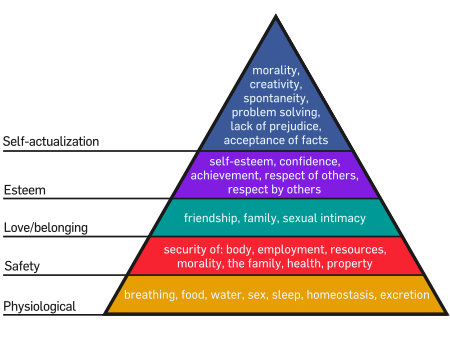
      The primary strength of ABMs is as a testing ground for a variety of theoretical assumptions and concepts about human behavior (Stanilov, 2012) within the safe environment of a computer simulation. For example, we know humans process sensory information about the environment, their own current state, and their remembered history to decide what actions to take (Kennedy, 2012) all of which can be incorporated within ABMs. Through the ability to model heterogeneity within ABMs we can capture the uniqueness that makes us human, in the sense that all humans have diverse personality traits (e.g. motivation, emotion, risk avoidance) and complex psychology (Bonabeau, 2002). We also know that human behavior is influenced by others (Friedkin and Johnsen, 1999) say via their social networks which can introduce positive and negative feedbacks into the system and when people form groups, results from such groups can be greater than the sum of the group (Hong and Page, 2004). These properties again can be captured through the agent’s heterogeneity and active status. However, what drives humans? What motivates us to take certain actions? By agents being active we can test ideas and theories (e.g. Maslow’s “Hierarchy of Needs” (Maslow, 1943)) on what motivates people and why do they do certain things.
      Maslow’s Hierarchy of Needs (Source: Wikipedia)
      The question of how to model decision-making within an agent-based model is another important consideration. Kennedy lists three main approaches to capturing such cognitive processes within ABMs (Kennedy, 2012). The first, being a mathematical approach such as the use of ad hoc direct and custom coding of behaviors within the simulation such as using random number generators to select a predefined possible choice (e.g. to buy or sell) (Gode and Sunder, 1993). But, as noted above, people are not random which has lead researchers to develop other methods such as directly incorporating threshold-based rules, i.e. when an environment parameter passes a certain threshold a specific agent behavior will result (e.g. move to a new location when the neighborhood composition reaches a certain percentage) (Crooks, 2010). One could argue that these approaches of modeling are appropriate when behavior can be well specified. The second approach to modeling human behavior uses conceptual cognitive frameworks. Within such models, instead of using thresholds, more abstract concepts such as beliefs, desires, and intentions (BDI, (Rao and Georgeff, 1991)) or physical, emotional, cognitive, and social factors (PECS, (Schmidt, 2002)) are given to individual agents. Both the BDI and PECS frameworks have been successively applied to modeling human behavior in a number of applications such as what drives people to crime (see (Brantingham et al., 2005) and (Malleson, 2012) respectively). These conceptual cognitive frameworks and mathematical approaches for representing behavior can both be considered as rule based systems and are often applied to tens to millions of agents. The third approach, that of cognitive architectures, (e.g. Soar (Laird, 2012) and ACT-R (Anderson and Lebiere, 1998)) focus on abstract or theoretical cognition of one agent at a time with a strong emphasis on artificial intelligence compared to the other two approaches.
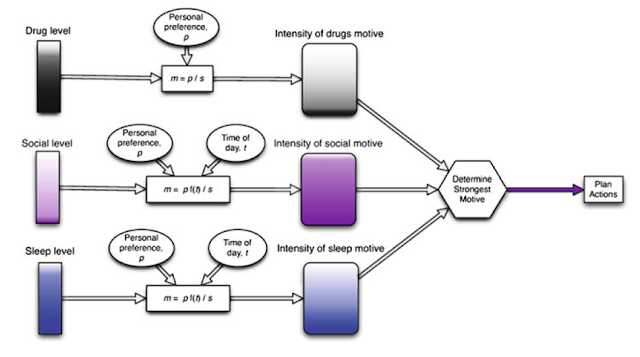
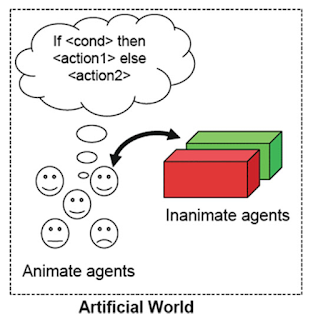
      Determining the strongest motive before planing an action (Source: Malleson, 2012).
      ABM offers a new lens to explore human behavior allowing us to move away from more traditional methods such as rational choice theory (Coleman, 1990), where it is assumed that humans behave in ways to maximize their benefits or minimize their costs. However, people rarely meet the requirements of rational choice models (Axelrod, 1997) in the sense that most, if not all people have limited cognitive abilities and limited time to make decisions (Simon, 1996). The incorporation of this bounded rationality (e.g. limited access to information) within agent-based models addresses this issue and can be used to explore many application domains where human behavior is important.

      Any thoughts or comments on what I have written here would be most appreciated.

      References

      • Anderson, J.R. and Lebiere, C. (1998), The Atomic Components of Thought, Mahwah, NJ.
      • Axelrod, R. (1997), ‘Advancing the Art of Simulation in the Social Sciences’, in Conte, R., Hegselmann, R. and Terno, P. (eds.), Simulating Social Phenomena, Springer, Berlin, Germany, pp. 21-40.
      • Bonabeau, E. (2002), ‘Agent-Based Modelling: Methods and Techniques for Simulating Human Systems’, Proceedings of the National Academy of Sciences of the United States of America, 99(3): 7280-7287.
      • Brantingham, P., Glasser, U., Kinney, B., Singh, K. and Vajihollahi, M. (2005), ‘A Computational Model for Simulating Spatial Aspects of Crime in Urban Environments.’ 2005 IEEE International Conference on Systems, Man and Cybernetics (Vol. 4), pp. 3667-3674.
      • Coleman, J.S. (1990), Foundations of Social Theory, Harvard University Press, Cambridge, MA.
      • Crooks, A.T. (2010), ‘Constructing and Implementing an Agent-Based Model of Residential Segregation through Vector GIS’, International Journal of GIS, 24(5): 661-675.
      • Friedkin, N.E. and Johnsen, E.C. (1999), ‘Social Influence Networks and Opinion Change’, Advances in Group Processes, 16(1-29).
      • Gode, D.K. and Sunder, S. (1993), ‘Allocative Efficiency of Markets with Zero-Intelligence Traders: Market as a Partial Substitute for Individual Rationality’, The Journal of Political Economy, 101: 119-137.
      • Hong, L. and Page, S.E. (2004), ‘Groups of Diverse Problem Solvers Can Outperform Groups of High-ability Problem Solvers’, Proceedings of the National Academic Sciences, 101(46): 16385-16389.
      • Kennedy, W. (2012), ‘Modelling Human Behaviour in Agent-Based Models’, in Heppenstall, A., Crooks, A.T., See, L.M. and Batty, M. (eds.), Agent-based Models of Geographical Systems, Springer, New York, NY, pp. 167-180.
      • Laird, J.E. (2012), The Soar Cognitive Architecture, The MIT Press, Cambridge, MA.
      • Malleson, N. (2012), ‘Using Agent-Based Models to Simulate Crime’, in Heppenstall, A., Crooks, A.T., See, L.M. and Batty, M. (eds.), Agent-based Models of Geographical Systems, Springer, New York, NY, pp. 411-434.
      • Maslow, A.H. (1943), ‘A Theory of Human Motivation’, Psychological Review, 50(4): 370-396.
      • Rao, A.S. and Georgeff, M.P. (1991), ‘Modeling Rational Agents within a BDI-architecture’, in Allen, J., Fikes, R. and Sandewall, E. (eds.), Proceedings of the Second International Conference on Principles of Knowledge Representation and Reasoning, San Mateo, CA.
      • Schmidt, B. (2002), ‘The Modelling of Human Behaviour: The PECS Reference Model’, Proceedings 14th European Simulation Symposium, Dresden, Germany.
      • Simon, H.A. (1996), The Sciences of the Artificial (3rd Edition), MIT Press, Cambridge, M. A.
      • Stanilov, K. (2012), ‘Space in Agent-Based Models’, in Heppenstall, A., Crooks, A.T., See, L.M. and Batty, M. (eds.), Agent-based Models of Geographical Systems, Springer, New York, NY, pp. 253-271.
        Continue reading »

        Modeling Human Behavior

        I have recently been thinking about how do people go about implementing human behavior within agent-based models. There are several good papers out their including Bill Kennedy’s (2012) paper entitled ‘Modelling Human Behavior in Agent-Based Models‘. I thought I would attempt to sum up some of these readings in a blog post but also add to how it links to the main properties of agent-based models.

        The reason I do this is that modeling human behavior is not as simple as it sounds. This is because, humans do not just make random decisions, but base their actions upon their knowledge and their abilities. Moreover, it might be nice to think that human behavior is rationale but this is not always the case, decisions can also be based on emotions (e.g. interest, happiness anger, and fear; see Izard, 2007). Moreover, emotions can influence ones decision making by altering our perceptions about the environment and future evaluations (Loewenstein and Lerner, 2003). The question therefore is how do we model human behavior? Over the last decade, one of the dominant ways of modeling human behavior in its many shapes and forms is through agent-based modeling (ABM). ABM allows us to focus on individuals or groups of individuals and give them diverse knowledge and abilities which is not possible in other modeling methodologies (see Crooks and Heppenstall, 2012). This is possible through the unique properties one can endow upon the agents (e.g. people) within such models (see Wooldridge and Jennings, 1995; Franklin and Graesser, 1996; Castle and Crooks, 2006). These properties include:

          • Autonomy: In sense that we can model individual autonomous units which are not centrally governed. Through this property agents are able to process and exchange information with other agents in order to make independent decisions.
          • Heterogeneity: Through using autonomous agents the notion of the average individual is redundant. Each agent can have their own properties and it’s these unique properties of individuals that cause more aggregate phenomena to develop.
          • Activity: As agents are autonomous individuals with heterogeneous properties, they can exert active independent influence within a simulation. There are several ways agents can do this from being proactive (goal directed) for example trying to solve a specific problem. Or they can be reactive, in the sense agents can be designed to perceive their surroundings and given prior knowledge based on experiences (e.g. learning) or observation and take actions accordingly.
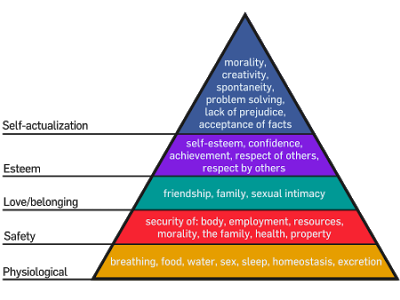
            The primary strength of ABMs is as a testing ground for a variety of theoretical assumptions and concepts about human behavior (Stanilov, 2012) within the safe environment of a computer simulation. For example, we know humans process sensory information about the environment, their own current state, and their remembered history to decide what actions to take (Kennedy, 2012) all of which can be incorporated within ABMs. Through the ability to model heterogeneity within ABMs we can capture the uniqueness that makes us human, in the sense that all humans have diverse personality traits (e.g. motivation, emotion, risk avoidance) and complex psychology (Bonabeau, 2002). We also know that human behavior is influenced by others (Friedkin and Johnsen, 1999) say via their social networks which can introduce positive and negative feedbacks into the system and when people form groups, results from such groups can be greater than the sum of the group (Hong and Page, 2004). These properties again can be captured through the agent’s heterogeneity and active status. However, what drives humans? What motivates us to take certain actions? By agents being active we can test ideas and theories (e.g. Maslow’s “Hierarchy of Needs” (Maslow, 1943)) on what motivates people and why do they do certain things.

            Maslow’s Hierarchy of Needs (Source: Wikipedia)
            The question of how to model decision-making within an agent-based model is another important consideration. Kennedy lists three main approaches to capturing such cognitive processes within ABMs (Kennedy, 2012). The first, being a mathematical approach such as the use of ad hoc direct and custom coding of behaviors within the simulation such as using random number generators to select a predefined possible choice (e.g. to buy or sell) (Gode and Sunder, 1993). But, as noted above, people are not random which has lead researchers to develop other methods such as directly incorporating threshold-based rules, i.e. when an environment parameter passes a certain threshold a specific agent behavior will result (e.g. move to a new location when the neighborhood composition reaches a certain percentage) (Crooks, 2010). One could argue that these approaches of modeling are appropriate when behavior can be well specified. The second approach to modeling human behavior uses conceptual cognitive frameworks. Within such models, instead of using thresholds, more abstract concepts such as beliefs, desires, and intentions (BDI, (Rao and Georgeff, 1991)) or physical, emotional, cognitive, and social factors (PECS, (Schmidt, 2002)) are given to individual agents. Both the BDI and PECS frameworks have been successively applied to modeling human behavior in a number of applications such as what drives people to crime (see (Brantingham et al., 2005) and (Malleson, 2012) respectively). These conceptual cognitive frameworks and mathematical approaches for representing behavior can both be considered as rule based systems and are often applied to tens to millions of agents. The third approach, that of cognitive architectures, (e.g. Soar (Laird, 2012) and ACT-R (Anderson and Lebiere, 1998)) focus on abstract or theoretical cognition of one agent at a time with a strong emphasis on artificial intelligence compared to the other two approaches.

            Determining the strongest motive before planing an action (Source: Malleson, 2012).
            ABM offers a new lens to explore human behavior allowing us to move away from more traditional methods such as rational choice theory (Coleman, 1990), where it is assumed that humans behave in ways to maximize their benefits or minimize their costs. However, people rarely meet the requirements of rational choice models (Axelrod, 1997) in the sense that most, if not all people have limited cognitive abilities and limited time to make decisions (Simon, 1996). The incorporation of this bounded rationality (e.g. limited access to information) within agent-based models addresses this issue and can be used to explore many application domains where human behavior is important.

            Any thoughts or comments on what I have written here would be most appreciated.

            References

            • Anderson, J.R. and Lebiere, C. (1998), The Atomic Components of Thought, Mahwah, NJ.
            • Axelrod, R. (1997), ‘Advancing the Art of Simulation in the Social Sciences’, in Conte, R., Hegselmann, R. and Terno, P. (eds.), Simulating Social Phenomena, Springer, Berlin, Germany, pp. 21-40.
            • Bonabeau, E. (2002), ‘Agent-Based Modelling: Methods and Techniques for Simulating Human Systems’, Proceedings of the National Academy of Sciences of the United States of America, 99(3): 7280-7287.
            • Brantingham, P., Glasser, U., Kinney, B., Singh, K. and Vajihollahi, M. (2005), ‘A Computational Model for Simulating Spatial Aspects of Crime in Urban Environments.’ 2005 IEEE International Conference on Systems, Man and Cybernetics (Vol. 4), pp. 3667-3674.
            • Coleman, J.S. (1990), Foundations of Social Theory, Harvard University Press, Cambridge, MA.
            • Crooks, A.T. (2010), ‘Constructing and Implementing an Agent-Based Model of Residential Segregation through Vector GIS’, International Journal of GIS, 24(5): 661-675.
            • Friedkin, N.E. and Johnsen, E.C. (1999), ‘Social Influence Networks and Opinion Change’, Advances in Group Processes, 16(1-29).
            • Gode, D.K. and Sunder, S. (1993), ‘Allocative Efficiency of Markets with Zero-Intelligence Traders: Market as a Partial Substitute for Individual Rationality’, The Journal of Political Economy, 101: 119-137.
            • Hong, L. and Page, S.E. (2004), ‘Groups of Diverse Problem Solvers Can Outperform Groups of High-ability Problem Solvers’, Proceedings of the National Academic Sciences, 101(46): 16385-16389.
            • Kennedy, W. (2012), ‘Modelling Human Behaviour in Agent-Based Models’, in Heppenstall, A., Crooks, A.T., See, L.M. and Batty, M. (eds.), Agent-based Models of Geographical Systems, Springer, New York, NY, pp. 167-180.
            • Laird, J.E. (2012), The Soar Cognitive Architecture, The MIT Press, Cambridge, MA.
            • Malleson, N. (2012), ‘Using Agent-Based Models to Simulate Crime’, in Heppenstall, A., Crooks, A.T., See, L.M. and Batty, M. (eds.), Agent-based Models of Geographical Systems, Springer, New York, NY, pp. 411-434.
            • Maslow, A.H. (1943), ‘A Theory of Human Motivation’, Psychological Review, 50(4): 370-396.
            • Rao, A.S. and Georgeff, M.P. (1991), ‘Modeling Rational Agents within a BDI-architecture’, in Allen, J., Fikes, R. and Sandewall, E. (eds.), Proceedings of the Second International Conference on Principles of Knowledge Representation and Reasoning, San Mateo, CA.
            • Schmidt, B. (2002), ‘The Modelling of Human Behaviour: The PECS Reference Model’, Proceedings 14th European Simulation Symposium, Dresden, Germany.
            • Simon, H.A. (1996), The Sciences of the Artificial (3rd Edition), MIT Press, Cambridge, M. A.
            • Stanilov, K. (2012), ‘Space in Agent-Based Models’, in Heppenstall, A., Crooks, A.T., See, L.M. and Batty, M. (eds.), Agent-based Models of Geographical Systems, Springer, New York, NY, pp. 253-271.
              Continue reading »

              Bob Woods Prize 2013

              TweetThe RGS-IBG Population Geography Research Group (PGRG) “Bob Woods Taught Postgraduate Dissertation (Masters) Prize” 2013. The prize is named in honour of Professor Bob Woods, who passed away in 2011. Bob was an esteemed population geographer, with interests across the sub-discipline. He made an invaluable contribution to population geography for many decades. For those of […]

              Continue reading »

              Lectureships in Human Geography – University of Bristol

              TweetLectureships in Human Geography Job number ACAD100190 Division/School School of Geographical Sciences Contract type Open ended contract staff Working pattern Full time Salary £34223 – £44607 pa Closing date for applications 04-Mar-2013 Human Geography Lectureships The School of Geographical Sciences at the University of Bristol seeks outstanding candidates for a number of lectureships in Human […]

              Continue reading »
              1 122 123 124 125 126 175