Cinematic Mapping
I recently posted a great visualisation showing 24 hour […]
Continue reading »The latest outputs from researchers, alumni and friends at the UCL Centre for Advanced Spatial Analysis (CASA).

I recently posted a great visualisation showing 24 hour […]
Continue reading »I recently posted a great visualisation showing 24 hour […]
Continue reading »
In a move to understand slums, we have switch gears slightly from agent-based modeling to a more statistical study of slums. To this end we have just received word that our paper entitled “Measuring Slum Severity in Mumbai and Kolkata: A Househol…
Continue reading »
In a move to understand slums, we have switch gears slightly from agent-based modeling to a more statistical study of slums. To this end we have just received word that our paper entitled “Measuring Slum Severity in Mumbai and Kolkata: A Househol…
Continue reading »I’ve written a very basic script to convert KML files into GeoJSON. This may be of use to any R users trying for the first time to get data from sources such as Google Earth or ScribbleMaps into the into webpages. Open the script in text editor first for instructions. Test the finished output in […]
Continue reading »I’ve seen a lot of very unhelpful comments lately, by men, on blogs, by women, usually ones women have written about sexism or some aspect of the way women are treated in particular high-skill industries (tech, science, journalism, or academia) … Continue reading →
I’ve seen a lot of very unhelpful comments lately, by men, on blogs, by women, usually ones women have written about sexism or some aspect of the way women are treated in particular high-skill industries (tech, science, journalism, or academia) … Continue reading →
Michael Mehaffy and Nikos Salingaros have written a nice paper on networks which is the online journal Biourbanism. They quote from E. Forster who made much in stories of the fact that we need to ‘connect’. His novella The Machine … Continue reading →
Continue reading »Showing where we live is, of course, one of the oldest […]
Continue reading »Showing where we live is, of course, one of the oldest […]
Continue reading »
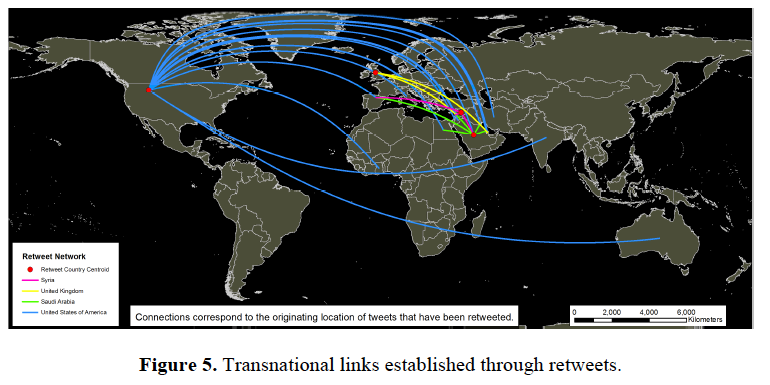
The international community can be viewed as a set of networks, manifested through various transnational activities. The availability of longitudinal datasets such as international arms trades and United Nations General Assembly (UNGA) allows for the study of state-driven interactions over time. In parallel to this top-down approach, the recent emergence of social media is fostering a bottom-up and citizen driven avenue for international relations (IR). The comparison of these two network types offers a new lens to study the alignment between states and their people. This paper presents a network-driven approach to analyze communities as they are established through different forms of bottom-up (e.g. Twitter) and top-down (e.g. UNGA voting records and international arms trade records) IR. By constructing and comparing different network communities we were able to evaluate the similarities between state-driven and citizen-driven networks. In order to validate our approach we identified communities in UNGA voting records during and after the Cold War. Our approach showed that the similarity between UNGA communities during and after the Cold War was 0.55 and 0.81 respectively (in a 0-1 scale). To explore the state- versus citizen-driven interactions we focused on the recent events within Syria within Twitter over a sample period of one month. The analysis of these data show a clear misalignment (0.25) between citizen-formed international networks and the ones established by the Syrian government (e.g. through its UNGA voting patterns).


Full reference:
Crooks, A.T., Masad, D., Croitoru, A., Cotnoir, A., Stefanidis, A. and Radzikowski, J. (2013), International Relations: State-Driven and Citizen-Driven Networks, Social Science Computer Review. DOI:10.1177/0894439313506851
 |
| Arms transfers |


The international community can be viewed as a set of networks, manifested through various transnational activities. The availability of longitudinal datasets such as international arms trades and United Nations General Assembly (UNGA) allows for the study of state-driven interactions over time. In parallel to this top-down approach, the recent emergence of social media is fostering a bottom-up and citizen driven avenue for international relations (IR). The comparison of these two network types offers a new lens to study the alignment between states and their people. This paper presents a network-driven approach to analyze communities as they are established through different forms of bottom-up (e.g. Twitter) and top-down (e.g. UNGA voting records and international arms trade records) IR. By constructing and comparing different network communities we were able to evaluate the similarities between state-driven and citizen-driven networks. In order to validate our approach we identified communities in UNGA voting records during and after the Cold War. Our approach showed that the similarity between UNGA communities during and after the Cold War was 0.55 and 0.81 respectively (in a 0-1 scale). To explore the state- versus citizen-driven interactions we focused on the recent events within Syria within Twitter over a sample period of one month. The analysis of these data show a clear misalignment (0.25) between citizen-formed international networks and the ones established by the Syrian government (e.g. through its UNGA voting patterns).
Full reference:
Crooks, A.T., Masad, D., Croitoru, A., Cotnoir, A., Stefanidis, A. and Radzikowski, J. (2013), International Relations: State-Driven and Citizen-Driven Networks, Social Science Computer Review. DOI:10.1177/0894439313506851
|
| Arms transfers |

Here’s a lovely hand-drawn map of central London […]
Continue reading »Two new publications set out to investigate the urban structure from a different angle than the ever same physical structure perspective. Whilst it might not as such mark a general shift in the way cities or urban areas are investigated these two publi…
Continue reading »
Both books are part of much larger ongoing research project supported by large national bodies, but operating internationally.
The first of the two books is Suburban Constellations. Governance, Land and Infrastructure in the 21st Century. edited by Roger Keil published by Jovis. It is in fact some kind of half time summary of the ongoing project (2010-2017) Global Suburbanisms: governance, land, and infrastructure in the 21st century. Here the group not only reports on findings, but it is also a tool to define the status quo and look ahead at what is to be achieved further down the line. The project is mainly supported by Social Science and Humanities Research Council of Canada but investigates case studies from around the world. One of the very striking themes in this project is to bring case studies of all those areas of urban sprawl from around the globe together and compare/contrast them.
The second book is Handmade urbanism: from community initiatives to participatory models : Mumbai, São Paulo, Istanbul, Mexico City, Cape Town edited by Marco L. Rosa and Ute E and published by Jovis. Weiland and is a publication that draws on the Urban Age project at home at LSE and famously sponsored by Deutsche Bank. Here the Project is already into its sixth year and a number of books where published in its context. Most prominently the Endless City (2008) and Living in the Endless City (2011) both by Burdett and Sudjic. This new publication specifically focuses on the Urban Age Award which is organised by the Alfred Herrhausen Society as part of the Urban Age Conferences. With a focus on what is happening on the ground it is based on interviews with different stakeholders in each of the projects world cities. Those five cities are Mumbai, Sao Paulo, Mexico City and Cape Town. The editor of this new publication Ute Weiland has for the past five years coordinated said awards and worked closely with the local contributors in all five cities.
What is special on those two publications is the angel they portrait the urban world and the focus they chose for the respective research projects. The main topic is the rapid urbanisation, the fact that 80% of the world’s population will be living in urbanised areas by 2050 that urban means collective and that cities are in constant flux.
The publisher house Jovis has already a bit of a history with similar publications. There is for example Matthew Gandy’s Urban Constellations (2011) as one of the recent publications in this area. In fact Keil does specifically refer to Gandy in his introduction and the two books even share partly the same title.
Suburban Constellations. Governance, Land and Infrastructure in the 21st Century. being a work in progress brings together a body of writings much more experimental and investigative in comparison. Whilst this might be interpreted as a lack of focus or clear scope at times, it does surprise the reader with raw concepts and very direct lines thought making for a joyful read. Further more it does not require to be read from cover to cover, rather it can be picket up to read just one of the essays and read others maybe later.
It is structured along four topics: Foundations, Themes, Essay and Images and Regions. The first topic presents some ‘foundational thinking on suburbanisation’. The second topic ‘elaborated on those themes with emphasis on redevelopment, risk, boundaries, water, sewage, and transportation. These topics intertwined with the research project’s main points of Land, Governance and Infrastructure. Whilst this organisational structure whilst they might make sense from a project point of view it not as easily accessible for the generally interested reader.
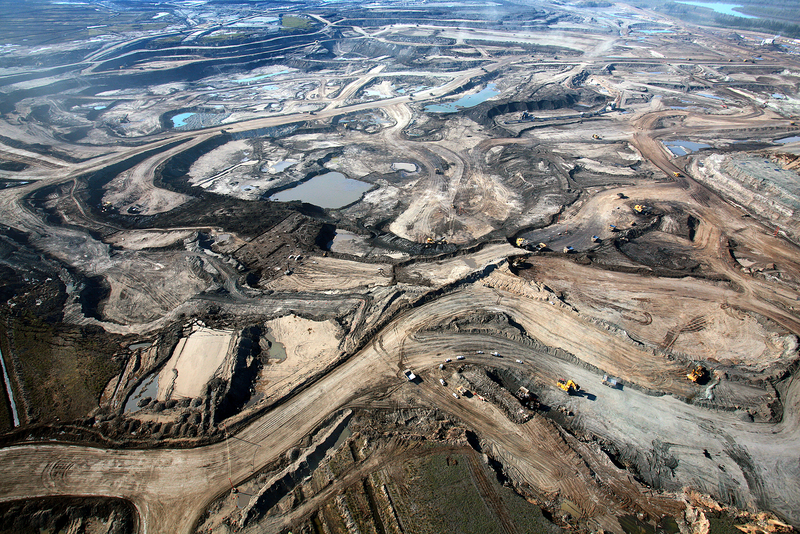 Image taken from the bad-news-beat.org / The waste lands of Fort Mcmurray AB.
The are pieces like “Forth McMurray, the Suburb sat the End of the Highway” by Clair Major describing the context of one of Canada’s two purely business driven settlements just north of Edmonton fuelled by the large oil sands. Or on the other hand an Essay by Alan Mabin “Suburbanisms in Africa” where he discusses not just the suburbs as places but mainly suburban as a term and its meaning in a culturally very different context. He for example points out how difficult it is to translate the term suburb or indeed suburbanises to other languages. For example in places such the urbanised areas of South Africa where beside the local/traditional languages plus English, French and Portuguese all compete for the meaning full expression such terminologies become very fluid in deed creating a complex concept of their own undermining all efforts to frame the topics with key terms.
The project plans a very comprehensive dissemination strategy including conferences and article, but also summer schools. So there will be much more to come from this project and research collective. Preview PDF for this publication is available HERE.
 Image taken from the perfact.org / Book spread Handmade Urbanism showing sketch illustrations.
Handmade urbanism: from community initiatives to participatory models : Mumbai, São Paulo, Istanbul, Mexico City, Cape Town has its focus on what is happening on the ground in each of the five metropolis regions and is being supported by the worldwide operating initiative Urban Age Award sponsored by Deutsche Bank.
The premise of the initiative is that empowering the local population and supporting them to organise their own projects will lead to more sustainable and lasting projects and increases the communities resilience. These aspects are investigated through the interviews and discussions each locations is portrayed by. This is frased by Wolfgang Nowak, the initiator of the Deutsche Bank Urban Age Award in his interview as: “I am not one of these people, like a Florence Nightingale, who stands and gives out soup to the poor (she has in fact done a whole lot more, for people and science). What we want is to enable the poor no longer to accept soup queues and produce their own soup.” (annotation added)
The book structure is organised along the cities. This main body is introduced by a series of essays creating a context for the project. These are by Wolfgang Nowak, Ute E. Wieland and Richard Sennett. These essays are not extensive in length, but try to be very concise.
The main part of the book presents a range of information about each location. There are basic statistics and data key figures information, and a short introduction to each of the three shortlisted projects. This is then followed by a series of interviews with local stakeholders. Experts from the jury, the local government as well as the project initiators.
The book also comes with a cd so you can in addition watch the documentary about the award and hear a bit more about community-driven initiatives. Runtime only 5:30. Also the publisher offers a online preview in PDF for this publication, available HERE.
Both books provide a good overview and outline of these kind of projects. Both projects have a large scope but the struggle between global level of organisation and local level of operation is very apparent. It leaves the reader wondering what exactly do we take from all this? Urban Constellations is the one that makes for a good read with experimental thoughts and Handmade Urbanism is the more descriptive discussion type of publication.
Graphically the two books have very different approaches. Handmade Urbanism translates the topic literally and all illustrations are hand drawn sketches and symbols. Urban Constellations makes extensive use of photographs documenting places mainly views onto or into suburbs. It however a rather weak part of the book, the illustrations do not live up to the surprises the essays manage to challenge the readers with.
 Image taken from the Perfact / Handmade Urbanism book cover.
Keil, R. ed., 2013. Suburban Constellations. Governance, Land and Infrastructure in the 21st Century., Berlin: Jovis Verlag.
Rosa, M.L. & Weiland, U.E. eds., 2013. Handmade urbanism: from community initiatives to participatory models : Mumbai, São Paulo, Istanbul, Mexico City, Cape Town, Berlin: Jovis Verlag.

Both books are part of much larger ongoing research project supported by large national bodies, but operating internationally.
The first of the two books is Suburban Constellations. Governance, Land and Infrastructure in the 21st Century. edited by Roger Keil published by Jovis. It is in fact some kind of half time summary of the ongoing project (2010-2017) Global Suburbanisms: governance, land, and infrastructure in the 21st century. Here the group not only reports on findings, but it is also a tool to define the status quo and look ahead at what is to be achieved further down the line. The project is mainly supported by Social Science and Humanities Research Council of Canada but investigates case studies from around the world. One of the very striking themes in this project is to bring case studies of all those areas of urban sprawl from around the globe together and compare/contrast them.
The second book is Handmade urbanism: from community initiatives to participatory models : Mumbai, São Paulo, Istanbul, Mexico City, Cape Town edited by Marco L. Rosa and Ute E and published by Jovis. Weiland and is a publication that draws on the Urban Age project at home at LSE and famously sponsored by Deutsche Bank. Here the Project is already into its sixth year and a number of books where published in its context. Most prominently the Endless City (2008) and Living in the Endless City (2011) both by Burdett and Sudjic. This new publication specifically focuses on the Urban Age Award which is organised by the Alfred Herrhausen Society as part of the Urban Age Conferences. With a focus on what is happening on the ground it is based on interviews with different stakeholders in each of the projects world cities. Those five cities are Mumbai, Sao Paulo, Mexico City and Cape Town. The editor of this new publication Ute Weiland has for the past five years coordinated said awards and worked closely with the local contributors in all five cities.
What is special on those two publications is the angel they portrait the urban world and the focus they chose for the respective research projects. The main topic is the rapid urbanisation, the fact that 80% of the world’s population will be living in urbanised areas by 2050 that urban means collective and that cities are in constant flux.
The publisher house Jovis has already a bit of a history with similar publications. There is for example Matthew Gandy’s Urban Constellations (2011) as one of the recent publications in this area. In fact Keil does specifically refer to Gandy in his introduction and the two books even share partly the same title.
Suburban Constellations. Governance, Land and Infrastructure in the 21st Century. being a work in progress brings together a body of writings much more experimental and investigative in comparison. Whilst this might be interpreted as a lack of focus or clear scope at times, it does surprise the reader with raw concepts and very direct lines thought making for a joyful read. Further more it does not require to be read from cover to cover, rather it can be picket up to read just one of the essays and read others maybe later.
It is structured along four topics: Foundations, Themes, Essay and Images and Regions. The first topic presents some ‘foundational thinking on suburbanisation’. The second topic ‘elaborated on those themes with emphasis on redevelopment, risk, boundaries, water, sewage, and transportation. These topics intertwined with the research project’s main points of Land, Governance and Infrastructure. Whilst this organisational structure whilst they might make sense from a project point of view it not as easily accessible for the generally interested reader.
Image taken from the bad-news-beat.org / The waste lands of Fort Mcmurray AB.
The are pieces like “Forth McMurray, the Suburb sat the End of the Highway” by Clair Major describing the context of one of Canada’s two purely business driven settlements just north of Edmonton fuelled by the large oil sands. Or on the other hand an Essay by Alan Mabin “Suburbanisms in Africa” where he discusses not just the suburbs as places but mainly suburban as a term and its meaning in a culturally very different context. He for example points out how difficult it is to translate the term suburb or indeed suburbanises to other languages. For example in places such the urbanised areas of South Africa where beside the local/traditional languages plus English, French and Portuguese all compete for the meaning full expression such terminologies become very fluid in deed creating a complex concept of their own undermining all efforts to frame the topics with key terms.
The project plans a very comprehensive dissemination strategy including conferences and article, but also summer schools. So there will be much more to come from this project and research collective. Preview PDF for this publication is available HERE.
Image taken from the perfact.org / Book spread Handmade Urbanism showing sketch illustrations.
Handmade urbanism: from community initiatives to participatory models : Mumbai, São Paulo, Istanbul, Mexico City, Cape Town has its focus on what is happening on the ground in each of the five metropolis regions and is being supported by the worldwide operating initiative Urban Age Award sponsored by Deutsche Bank.
The premise of the initiative is that empowering the local population and supporting them to organise their own projects will lead to more sustainable and lasting projects and increases the communities resilience. These aspects are investigated through the interviews and discussions each locations is portrayed by. This is frased by Wolfgang Nowak, the initiator of the Deutsche Bank Urban Age Award in his interview as: “I am not one of these people, like a Florence Nightingale, who stands and gives out soup to the poor (she has in fact done a whole lot more, for people and science). What we want is to enable the poor no longer to accept soup queues and produce their own soup.” (annotation added)
The book structure is organised along the cities. This main body is introduced by a series of essays creating a context for the project. These are by Wolfgang Nowak, Ute E. Wieland and Richard Sennett. These essays are not extensive in length, but try to be very concise.
The main part of the book presents a range of information about each location. There are basic statistics and data key figures information, and a short introduction to each of the three shortlisted projects. This is then followed by a series of interviews with local stakeholders. Experts from the jury, the local government as well as the project initiators.
The book also comes with a cd so you can in addition watch the documentary about the award and hear a bit more about community-driven initiatives. Runtime only 5:30. Also the publisher offers a online preview in PDF for this publication, available HERE.
Both books provide a good overview and outline of these kind of projects. Both projects have a large scope but the struggle between global level of organisation and local level of operation is very apparent. It leaves the reader wondering what exactly do we take from all this? Urban Constellations is the one that makes for a good read with experimental thoughts and Handmade Urbanism is the more descriptive discussion type of publication.
Graphically the two books have very different approaches. Handmade Urbanism translates the topic literally and all illustrations are hand drawn sketches and symbols. Urban Constellations makes extensive use of photographs documenting places mainly views onto or into suburbs. It however a rather weak part of the book, the illustrations do not live up to the surprises the essays manage to challenge the readers with.
Image taken from the Perfact / Handmade Urbanism book cover.
Keil, R. ed., 2013. Suburban Constellations. Governance, Land and Infrastructure in the 21st Century., Berlin: Jovis Verlag.
Rosa, M.L. & Weiland, U.E. eds., 2013. Handmade urbanism: from community initiatives to participatory models : Mumbai, São Paulo, Istanbul, Mexico City, Cape Town, Berlin: Jovis Verlag.

Both books are part of much larger ongoing research project supported by large national bodies, but operating internationally.
The first of the two books is Suburban Constellations. Governance, Land and Infrastructure in the 21st Century. edited by Roger Keil published by Jovis. It is in fact some kind of half time summary of the ongoing project (2010-2017) Global Suburbanisms: governance, land, and infrastructure in the 21st century. Here the group not only reports on findings, but it is also a tool to define the status quo and look ahead at what is to be achieved further down the line. The project is mainly supported by Social Science and Humanities Research Council of Canada but investigates case studies from around the world. One of the very striking themes in this project is to bring case studies of all those areas of urban sprawl from around the globe together and compare/contrast them.
The second book is Handmade urbanism: from community initiatives to participatory models : Mumbai, São Paulo, Istanbul, Mexico City, Cape Town edited by Marco L. Rosa and Ute E and published by Jovis. Weiland and is a publication that draws on the Urban Age project at home at LSE and famously sponsored by Deutsche Bank. Here the Project is already into its sixth year and a number of books where published in its context. Most prominently the Endless City (2008) and Living in the Endless City (2011) both by Burdett and Sudjic. This new publication specifically focuses on the Urban Age Award which is organised by the Alfred Herrhausen Society as part of the Urban Age Conferences. With a focus on what is happening on the ground it is based on interviews with different stakeholders in each of the projects world cities. Those five cities are Mumbai, Sao Paulo, Mexico City and Cape Town. The editor of this new publication Ute Weiland has for the past five years coordinated said awards and worked closely with the local contributors in all five cities.
What is special on those two publications is the angel they portrait the urban world and the focus they chose for the respective research projects. The main topic is the rapid urbanisation, the fact that 80% of the world’s population will be living in urbanised areas by 2050 that urban means collective and that cities are in constant flux.
The publisher house Jovis has already a bit of a history with similar publications. There is for example Matthew Gandy’s Urban Constellations (2011) as one of the recent publications in this area. In fact Keil does specifically refer to Gandy in his introduction and the two books even share partly the same title.
Suburban Constellations. Governance, Land and Infrastructure in the 21st Century. being a work in progress brings together a body of writings much more experimental and investigative in comparison. Whilst this might be interpreted as a lack of focus or clear scope at times, it does surprise the reader with raw concepts and very direct lines thought making for a joyful read. Further more it does not require to be read from cover to cover, rather it can be picket up to read just one of the essays and read others maybe later.
It is structured along four topics: Foundations, Themes, Essay and Images and Regions. The first topic presents some ‘foundational thinking on suburbanisation’. The second topic ‘elaborated on those themes with emphasis on redevelopment, risk, boundaries, water, sewage, and transportation. These topics intertwined with the research project’s main points of Land, Governance and Infrastructure. Whilst this organisational structure whilst they might make sense from a project point of view it not as easily accessible for the generally interested reader.
Image taken from the bad-news-beat.org / The waste lands of Fort Mcmurray AB.
The are pieces like “Forth McMurray, the Suburb sat the End of the Highway” by Clair Major describing the context of one of Canada’s two purely business driven settlements just north of Edmonton fuelled by the large oil sands. Or on the other hand an Essay by Alan Mabin “Suburbanisms in Africa” where he discusses not just the suburbs as places but mainly suburban as a term and its meaning in a culturally very different context. He for example points out how difficult it is to translate the term suburb or indeed suburbanises to other languages. For example in places such the urbanised areas of South Africa where beside the local/traditional languages plus English, French and Portuguese all compete for the meaning full expression such terminologies become very fluid in deed creating a complex concept of their own undermining all efforts to frame the topics with key terms.
The project plans a very comprehensive dissemination strategy including conferences and article, but also summer schools. So there will be much more to come from this project and research collective. Preview PDF for this publication is available HERE.
Image taken from the perfact.org / Book spread Handmade Urbanism showing sketch illustrations.
Handmade urbanism: from community initiatives to participatory models : Mumbai, São Paulo, Istanbul, Mexico City, Cape Town has its focus on what is happening on the ground in each of the five metropolis regions and is being supported by the worldwide operating initiative Urban Age Award sponsored by Deutsche Bank.
The premise of the initiative is that empowering the local population and supporting them to organise their own projects will lead to more sustainable and lasting projects and increases the communities resilience. These aspects are investigated through the interviews and discussions each locations is portrayed by. This is frased by Wolfgang Nowak, the initiator of the Deutsche Bank Urban Age Award in his interview as: “I am not one of these people, like a Florence Nightingale, who stands and gives out soup to the poor (she has in fact done a whole lot more, for people and science). What we want is to enable the poor no longer to accept soup queues and produce their own soup.” (annotation added)
The book structure is organised along the cities. This main body is introduced by a series of essays creating a context for the project. These are by Wolfgang Nowak, Ute E. Wieland and Richard Sennett. These essays are not extensive in length, but try to be very concise.
The main part of the book presents a range of information about each location. There are basic statistics and data key figures information, and a short introduction to each of the three shortlisted projects. This is then followed by a series of interviews with local stakeholders. Experts from the jury, the local government as well as the project initiators.
The book also comes with a cd so you can in addition watch the documentary about the award and hear a bit more about community-driven initiatives. Runtime only 5:30. Also the publisher offers a online preview in PDF for this publication, available HERE.
Both books provide a good overview and outline of these kind of projects. Both projects have a large scope but the struggle between global level of organisation and local level of operation is very apparent. It leaves the reader wondering what exactly do we take from all this? Urban Constellations is the one that makes for a good read with experimental thoughts and Handmade Urbanism is the more descriptive discussion type of publication.
Graphically the two books have very different approaches. Handmade Urbanism translates the topic literally and all illustrations are hand drawn sketches and symbols. Urban Constellations makes extensive use of photographs documenting places mainly views onto or into suburbs. It however a rather weak part of the book, the illustrations do not live up to the surprises the essays manage to challenge the readers with.
Image taken from the Perfact / Handmade Urbanism book cover.
Keil, R. ed., 2013. Suburban Constellations. Governance, Land and Infrastructure in the 21st Century., Berlin: Jovis Verlag.
Rosa, M.L. & Weiland, U.E. eds., 2013. Handmade urbanism: from community initiatives to participatory models : Mumbai, São Paulo, Istanbul, Mexico City, Cape Town, Berlin: Jovis Verlag.
This international seminar gathers experts in the field of multiple citizenship and migration, especially Latin Americans in the World. It aims to establish a debate about the innovative practices generated by this collective of multiple citizens, and their implications for … Continue reading →
Continue reading »
Similarly to many branches of statistics-gathering, the world’s trade statistics bureaux lack, in their communication style, a certain panache. The writings of such agencies are characterised by a complete absence of zing, lightness-of-touch and joie de vivre. I’ve blogged before about horrific diagrams like that shown here, and how the whole enterprise of gathering information […]
Continue reading »
The above extract is from a map that we’ve wanted […]
Continue reading »Read our editorial in the current issue of Transactions in GIS about “Applied Urban Modeling: New Types of Spatial Data Provide a Catalyst for New Models”. The issues contains four papers on recent developments in urban modelling originally presented at … Continue reading →
Continue reading »|
New map based on TfL data shows cycle traffic flows in central London
road.cc Oliver O’Brien, a research assistant at the Centre for Advanced Spatial Analysis at University College London, used TfL Traffic Census Data to produce what he has called the London Cycle Census Map. You can find it here. The data, not made publicly … |
|
New map based on TfL data shows cycle traffic flows in central London
road.cc Oliver O’Brien, a research assistant at the Centre for Advanced Spatial Analysis at University College London, used TfL Traffic Census Data to produce what he has called the London Cycle Census Map. You can find it here. The data, not made publicly … |
|
New map based on TfL data shows cycle traffic flows in central London
road.cc Oliver O’Brien, a research assistant at the Centre for Advanced Spatial Analysis at University College London, used TfL Traffic Census Data to produce what he has called the London Cycle Census Map. You can find it here. The data, not made publicly … |
Ollie O’Brien and I have just dropped off our inv […]
Continue reading »Ollie O’Brien and I have just dropped off our inv […]
Continue reading »New map based on TfL data shows cycle traffic flows in central London road.ccA data-mapping specialist has used Transport for London (TfL) traffic data to show how bicycles are becoming the most used mode of transport at some …
Continue reading »New map based on TfL data shows cycle traffic flows in central London road.ccA data-mapping specialist has used Transport for London (TfL) traffic data to show how bicycles are becoming the most used mode of transport at some …
Continue reading »New map based on TfL data shows cycle traffic flows in central London road.ccA data-mapping specialist has used Transport for London (TfL) traffic data to show how bicycles are becoming the most used mode of transport at some …
Continue reading »|
London cycling census mapped: where do cyclists outnumber drivers?
The Guardian (blog) Using newly released data from Transport for London’s cycle traffic census, University College London Centre for Advanced Spatial Analysis (UCL CASA) Research Associate Oliver O’Brien has created an interactive map showing traffic flows on key routes … |
|
London cycling census mapped: where do cyclists outnumber drivers?
The Guardian (blog) Using newly released data from Transport for London’s cycle traffic census, University College London Centre for Advanced Spatial Analysis (UCL CASA) Research Associate Oliver O’Brien has created an interactive map showing traffic flows on key routes … |

The London Cycling Census Map is an interactive map I’ve created, showing traffic flows on key corridors in central London. The counts were collected by Transport for London in around 170 locations, in April. TfL released some sample statistics from the dataset in a report published on their website, but the original dataset was not […]
Continue reading »
The London Cycling Census Map is an interactive map I’ve created, showing traffic flows on key corridors in central London. The counts were collected by Transport for London in around 170 locations, in April. TfL released some sample statistics from the dataset in a report published on their website, but the original dataset was not […]
Continue reading »London cycling census mapped: where do cyclists outnumber drivers? The Guardian
Continue reading »This stunning animation (complete with a dramatic sound […]
Continue reading »This stunning animation (complete with a dramatic sound […]
Continue reading »

What would happen if we could make a machine that recognizes emotions? And further, what if we could make a machine that has ‘emotions’?How would ‘it’ communicate and to what effect? In 2009, the Edinburgh-based, art collective FOUND, created the Cybraphon, a musical automaton inspired by the play-pianos of the 19th […]
The post Cybraphon, a robot with feelings appeared first on CEDE.
Continue reading »My current editorial in Environment and Planning B deals with the impact that the technologies we invent have on the very object that we are studying with the same technologies: using computers to study cities that are now composed of … Continue reading →
Continue reading »
In the dystopian science fiction movie Blade Runner a Voight-Kampff machine (VKM) was used to test and distinguish between humans and replicants based on the emphatic response to test questions. This fictional machine measures empathy based on biometrical reactions (e.g. eye movement, heart rate, blush response) to emotional questions. The […]
The post The Voight-Kampff Machine… appeared first on CEDE.
Continue reading »
One of my earliest projects at UCL, back in 2009, was t […]
Continue reading »