Data Hub Shows Weather, News & Transport Info For Major UK Cities – PSFK
CityDashboard includes a live feed and a map detailing what’s happening in eight cities across Britain.See it on Scoop.it, via Spatial Analysis
Continue reading »The latest outputs from researchers, alumni and friends at the UCL Centre for Advanced Spatial Analysis (CASA).

CityDashboard includes a live feed and a map detailing what’s happening in eight cities across Britain.See it on Scoop.it, via Spatial Analysis
Continue reading »CityDashboard aggregates real-time data for cities around the UK and presents the information on a webpage and map. The project was created by the Centre for Advanced Spatial Analysis at University College London. The dashboard of live feeds displays a…
Continue reading »Jason Silva’s wonderful demonstration of patterns and order across many evolving spatial systems is what our science of cities is all about: flows, interactions, dynamics, self-similiarity, hierarchy and of course fractals. Take a look. These patterns swirl around all our … Continue reading →
Continue reading »The BBC’s science series ‘Bang goes the Theory’ recently had an episode on crowd behaviour. It shows a fascinating way of getting plenty of research out there into the public eye, using very short clips of research taking place based on certain themes….
Continue reading »The BBC’s science series ‘Bang goes the Theory’ recently had an episode on crowd behaviour. It shows a fascinating way of getting plenty of research out there into the public eye, using very short clips of research taking place based on certain themes….
Continue reading »The BBC’s science series ‘Bang goes the Theory’ recently had an episode on crowd behaviour. It shows a fascinating way of getting plenty of research out there into the public eye, using very short clips of research taking place based on certain themes….
Continue reading »Last Saturday, 5 May 2012, saw the FA Cup Final and various Olympics preparation events taking place in London, so I couldn’t help wondering was was going to happen to the transport system. The ANTS project (Adaptive Networks for complex Transport Systems) that I’ve been working on is designed as a toolkit for collecting transport … Read more →
Continue reading »This column previously covered a neat experiment that was using open data for London’s air quality to point out automatically areas of iffy air quality on Twitter.See it on Scoop.it, via Spatial Analysis
Continue reading »Over the last few weeks we have been looking at ESRI’s CityEngine and how it can be used to create rapid urban scenes. As we noted it moves GIS visualisation a step forward while at the same time bringing procedural city modelling into the ma…
Continue reading »See it on Scoop.it, via Spatial Analysis
Continue reading »I was at the third WhereCampEU “unconference” which took place in Amsterdam over the last weekend of April, following previous editions in London and Berlin which I was also at. The meeting was an ideal opportunity for me to feature … Continue reading →
Continue reading »Blood is everywhere when it comes to describing cities. We have arterial roads, pulsing transport flows, and cities with different metabolisms. Thanks to great new datasets and visualisation software the analogy of cities with pulsing flows is being increasingly utilised for explanatory mapping. For example the work of UCL CASA’s Jon Reades above depicts the London Underground network …
Continue reading »As I get to better grips with the full richness of the Oyster data set and the complexity of the TfL network it’s gradually getting easier to build better visualisations. One of the ones that I’ve wanted to revisit for quite some time was my original ‘pulse of the city’ animation (you can see it […]
Continue reading »I’ve been meaning to post this for ages but have had a great deal on my plate (more posts and visualisations to follow in the next week I hope) so this has kept slipping, together with the six or seven other ‘draft’ posts I’ve got going. Anyway, this visualisation shows average entries at each and every Underground, […]
Continue reading »I’ve just released Spindlytext on Github. It’s the library that powers the live data display in Pigeon Sim, by creating KML linestrings in the shape of letters. It looks like this:
Continue reading »We featured the first official Olympic Park map at the […]
Continue reading »Here’s a map of England, overlaid on it is a choropleth map showing the modal (i.e most common) council tax band within each Census Output Area (OA) in England, based on March 2011 data released by the Office of National … Continue reading →
Continue reading »‘Modelling Movement in the City: The Influence of Individuals’ was the title of a talk I gave at the AGILE conference in Avignon, France last week. For the conference I actually initially prepared a poster that never ended up seeing the light of d…
Read more →
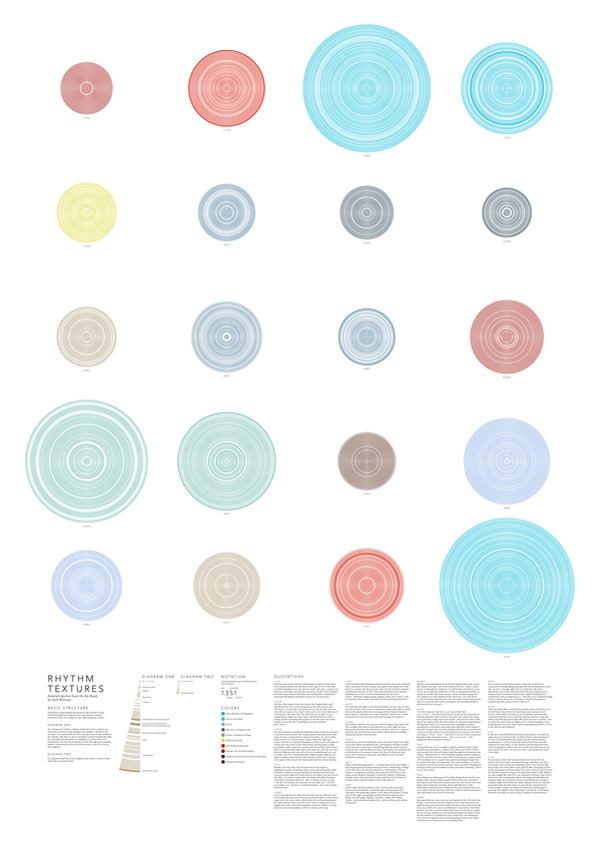
Image taken from aestheticsofjoy by Stephanie Posavec / Writing without words exploring possibilities to visually represent text.
Of course info graphics are currently trending and one of the most talked and specially passed around topic, not only online but more recently also in the media. All the large media houses have a special information design group and the publication showcases a number of these examples. In this context the book is not the first such collection of good designed information, but certainly one of the boldest in a positive sense.
The publication is edited by Julius Wiedemann und features contributions by Sandra Rendgen, Richard Saul Wurman, Simon Rogers from the Guardian Data Blog and Paolo Ciuccarelli. This is a very interesting team Taschen has put together for this publication with, whilst still being information specialists, covering a broad spectrum of perspectives and expertise.


Image taken from dynamicdiagrams by NYT / Interactive visualisation showing the changes in election results over the period 2006-2010. Find the interactive version at NYT
Where other publications, for examples Data Flow by Gestalten, Otto Neurat by NAi or indeed Edward Tufte focus on the context of the graphics, the theoretical background of narrating information as well as the actual teaching of how to present information the Taschen publication is a showcase. It is foremost about showing great examples from a variety of sources on how to visualise data sets graphically in mainly 2D. There are a few web based, animated or interactive examples too though. This takes into account that complexity showing in these graphics is continually rising.


Image by Torgeir Husevaag / Escape Routes, 2010-2011. A series of drawing studying possibilities of spatial movement under given time constraints. On the left the map and on the right a detail of some of the blue shaded location sixth path details
Showcasing such a large collection of examples is tricky in that the ordering system as to how the examples are organised becomes very prominent and therefore important. Here the editor has decided to go with a very low number of groups to arrange the info graphics. Where other publications make an exercise out of inventing a whole new system to clarify and characterise the examples this one takes the simple approach. This both refreshingly straight forward and annoyingly rough. What do the chosen terms Location, Time, Category and Hierarchy actually describe, or more importantly how are they distinguished?
The questions remain unanswered however, this does not stand in the way to enjoy the great quality and variety this collection shows. Its a book to brows, jump and flip, a publication you will keep in reach for a long time and always go back to to enjoy or indeed recharge your design batteries.
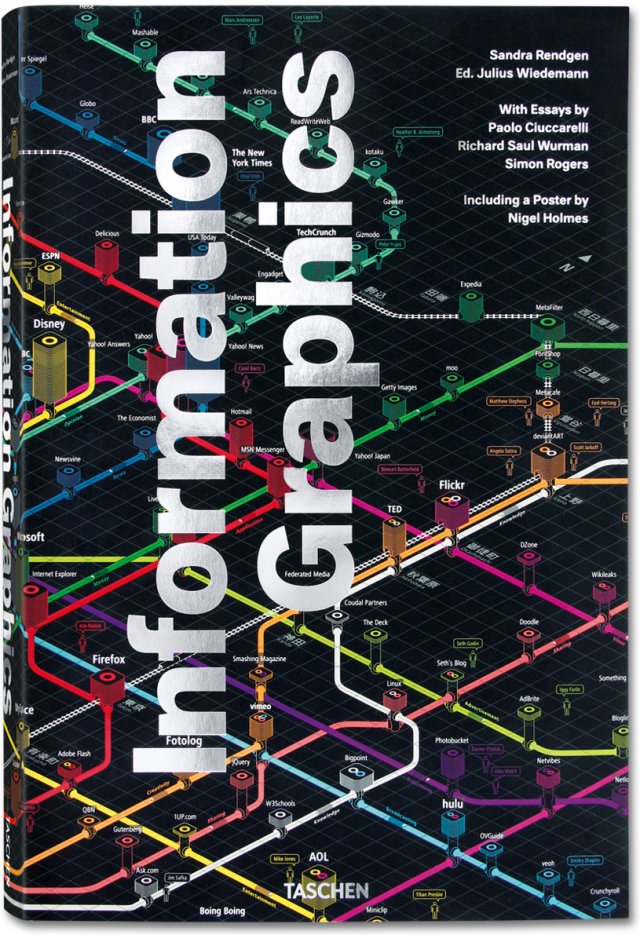
Image by Taschen / Book cover Information Graphics.
Rendgen, S., 2012. Information Graphics J. Wiedemann, ed., Köln: Taschen GmbH.
Image taken from aestheticsofjoy by Stephanie Posavec / Writing without words exploring possibilities to visually represent text.
Of course info graphics are currently trending and one of the most talked and specially passed around topic, not only online but more recently also in the media. All the large media houses have a special information design group and the publication showcases a number of these examples. In this context the book is not the first such collection of good designed information, but certainly one of the boldest in a positive sense.
The publication is edited by Julius Wiedemann und features contributions by Sandra Rendgen, Richard Saul Wurman, Simon Rogers from the Guardian Data Blog and Paolo Ciuccarelli. This is a very interesting team Taschen has put together for this publication with, whilst still being information specialists, covering a broad spectrum of perspectives and expertise.
Image taken from dynamicdiagrams by NYT / Interactive visualisation showing the changes in election results over the period 2006-2010. Find the interactive version at NYT
Where other publications, for examples Data Flow by Gestalten, Otto Neurat by NAi or indeed Edward Tufte focus on the context of the graphics, the theoretical background of narrating information as well as the actual teaching of how to present information the Taschen publication is a showcase. It is foremost about showing great examples from a variety of sources on how to visualise data sets graphically in mainly 2D. There are a few web based, animated or interactive examples too though. This takes into account that complexity showing in these graphics is continually rising.
Image by Torgeir Husevaag / Escape Routes, 2010-2011. A series of drawing studying possibilities of spatial movement under given time constraints. On the left the map and on the right a detail of some of the blue shaded location sixth path details
Showcasing such a large collection of examples is tricky in that the ordering system as to how the examples are organised becomes very prominent and therefore important. Here the editor has decided to go with a very low number of groups to arrange the info graphics. Where other publications make an exercise out of inventing a whole new system to clarify and characterise the examples this one takes the simple approach. This both refreshingly straight forward and annoyingly rough. What do the chosen terms Location, Time, Category and Hierarchy actually describe, or more importantly how are they distinguished?
The questions remain unanswered however, this does not stand in the way to enjoy the great quality and variety this collection shows. Its a book to brows, jump and flip, a publication you will keep in reach for a long time and always go back to to enjoy or indeed recharge your design batteries.
Image by Taschen / Book cover Information Graphics.
Rendgen, S., 2012. Information Graphics J. Wiedemann, ed., Köln: Taschen GmbH.
Click the map to start the wind flowing* Many years ago, Waldo Tobler provided the inspiration for mapping and modelling flows as potentials, possibly following Ravenstein, developing the simple concept of an ‘interaction wind’. His insight continues and now with … Continue reading →
Continue reading »Material and people flows in cities show atoms are bonded together but money and information flows have much greater resonance. The great challenge is not only to build good economic flow models but first to observe and measure them. Pioneering … Continue reading →
Continue reading »The London Data Table was one of my personal favourites from the exhibition accompanying the CASA “Smart Cities” conference which took place at the University of London last Friday. The concept was thought up by Steven Gray and it consists … Continue reading →
Continue reading »As regular readers will know we recently held a one day conference here at CASA entitled Smart Cities, Bridging the Physical and Digital. As part of the conference Steven Gray and George MacKerron built various exhibition pieces, in…
Continue reading »We recently held a one day conference here at CASA called Smart Cities. For the conference we built various exhibition pieces and my contribution to the conference was the London Data Table, a projection table the shape of Greater London. The table had various visualisation projected onto the surface; from live aircraft positions, live traffic […]
Continue reading »Nice write up of CityDB See it on Scoop.it, via Spatial Analysis
Continue reading »I recently had the pleasure of presenting at the first Data Visualisation London Meetup event where I spoke about some of work we do at UCL CASA. A fair chunk of the slides were movies so I thought it best to stick them in a blog post. If you like what you see you can …
Continue reading »Scroll down for articleSee it on Scoop.it, via Spatial Analysis
Continue reading »Introducing Citydashboard.org: A Live View of City Data – here at the Centre for Advanced Spatial Analysis, University College London, we have just made live our latest in a series of services examining live data feeds – CityDashBoard. The system pulls in data from a variety feeds, developing our view that the next trend in…
Here at the Centre for Advanced Spatial Analysis, University College London, we have just made live our latest in a series of services examining live data feeds – CityDashBoard. The system pulls in data from a variety feeds, de…
Continue reading »Last Friday (April 20th) over 350 members of the public attended our Smart Cities ‘Bridging Physical and Digital’ open day and conference at Senate House, London. The full day of talks, accompanied by the Smart Cities exhibition, was aimed at openi…
Continue reading »City Dashboard Gives Realtime Info About London LondonistEver wondered how much radiation there is in London?
Continue reading »On Monday, UCL public engagement played host to a new type of event, funded by EPSRC and titled Focus On The Positive. The idea is beautifully simple – six academics […]
Continue reading »To quote from the site “The SimTable takes sandtable exercise to the next level by making sandtables real. The SimTable is a 3D interactive fire simulator, bringing sandtable exercises to life.” Below is a Los Alamos National Lab video demonstrating th…
Continue reading »To quote from the site “The SimTable takes sandtable exercise to the next level by making sandtables real. The SimTable is a 3D interactive fire simulator, bringing sandtable exercises to life.” Below is a Los Alamos National Lab video demonstrating th…
Continue reading »Here are the colour ramps I am using for numeric measures in the recently launched CityDashboard (which by the way now has a new URL – http://citydashboard.org/): The colours have been designed to be clearly distinguishable from the white text … Continue reading →
Continue reading »TweetA conference held under the auspices of the ESRC Centre for Population Change (CPC) and the RGS-IBG Population Geography Research Group (PGRG) 2nd-3rd July 2012, University of St Andrews We are pleased to announce that participant registration for this conference is now open. The meeting is timed to finish at lunchtime on Tuesday 3rd July […]
Continue reading »Urban well-being could be boosted thanks to lessons learned from tracking people through a city’s underground travel network…See it on Scoop.it, via Spatial Analysis
Continue reading »Getting the “pulse” of a city in real-time is a tricky job, but a team working at the Centre for Applied Spatial Analysis at UCL has come up with a dashboard for visualising key information about the place you live…See it on Scoop.it, via Spatial An…
Continue reading »