Latest Posts

Book – Landscape Observer: London, on Pops and Democracy

London has seen a boom in inner-city developments over the past five to ten years. Large areas have been transformed, become densified in many ways and existing development has been replaced to make way for huge investments. Along it came a number of landscape projects to design pleasing outdoor spaces.

London is comparably green for its size with many streets tree-lined and many public parks. However, the everyday location in this bustling city is still dominated by hard surfaces. Greenery is rare and often not maintained. Especially with the government’s ongoing austerity programmes, the local councils struggle to keep up maintenance.

To distinguish themselves investors invest big in the design of the surroundings of their buildings. It underlines the quality to justify sky-high rents. The public is invited in to generate footfall for rented spaces. Where previously private property was fenced off, investors have discovered the potential of beautiful spaces. It seems a win-win situation, the public gets more greened spaces, the local councils get well maintained outdoor spaces and the investors can secure their investment.

The numerous places that have sprung up across London are now documented in a new JOVIS publication Landscape Observer: London by Vladimir Guculak. The book acts as a guide, but also a repository of not just a handful, but some 89 projects. Ranging from large-scale projects like Kings Cross redevelopment in central London to the Cutty Sark Gardens in Greenwich and other smaller projects.
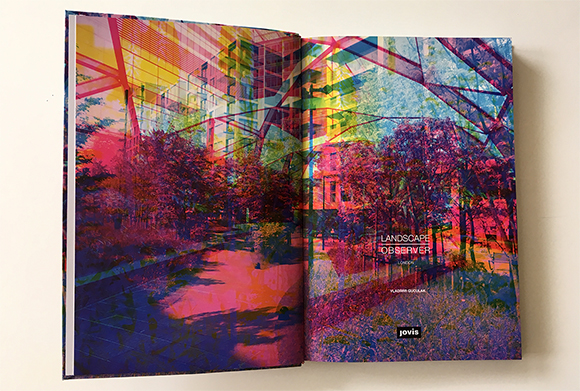

Image own / Title page of the pubication Landscape Observer: London, by Vladimir Guculak, 2017.

Each project is in detail documented with photographs by the author, a landscape architect himself, with additional information about location, size, year, designer, nearest public transport and accessibility information. Each chapter is proceeded by a map that helps locate each open space in the context of the city.

It is a beautifully designed publication complete with artwork by the author. With the photographic documentation, the publication gives an overview of the project and a number of detail shots to highlight specific areas and in some cases construction details. Along the photos, the author does give a brief listing of plants included, materials used and other special features such a street furniture and lighting.

Image taken from London Fieldwork / Spontaneous City in the Tree of Heaven

It also features a personal favourite the Duncan Terrace Gardens (p.18). With a very inspiring artwork by London Fieldwork Spontaneous City in the Tree of Heaven. Or the nice-to-be-in-the-summer-with-kids Diana, Princess of Wales Memorial Fountain in Hyde Park.

The weather is always extremely sunny throughout this publication and everything is documented in bloom with green lush leaves. It might seem a good idea to show summer, but landscaping has to work 12 months a year not only three or four. This is especially true for English weather and seasons. Colourful autumn leaves are as beautiful if not more so and stormy or rainy conditions can make for dramatically romantic scenes. So not why not make use of it?

However, there are some more important problems with this publication. And it’s not that something like the John Lewis Rain Garden (p.81) designed by the prominent designer (Nigel Dunnett) of the 2012 Olympic Parc in Stratford (now Queen Elizabeth Olympic Parc) features as a model “public space”. The main problem is the nonchalant attitude towards public space.

Public space is one of the most important principles to an accessible and shared city that is open to everyone. It is highly political and can be linked to the concept of the city-state in ancient Greece with the Agora, the foundation of democracy. See for example Sennett, Richard, 1998. The Spaces of Democracy, 1998 Raoul Wallenberg Lecture or Henry Lefebvre, 1974 (1991 e). The Production of Space, Blackwell. p.237-241. We don’t need to launch into a manifesto for the open city here, others have done so much more thoroughly. Nevertheless, the open and shared spaces are fundamental to living together in an open democratic city.

The problem with public spaces is the creeping rise of POPS or pseudo-public spaces. These spaces look and feel like public spaces but are in fact private spaces. They are on privately owned land and therefore are governed by a very different set of rules. Rules that are made up by the private owner and rarely publicly shared. The fact that one can access a street, a square or a riverside does not for a long shot make it public space.

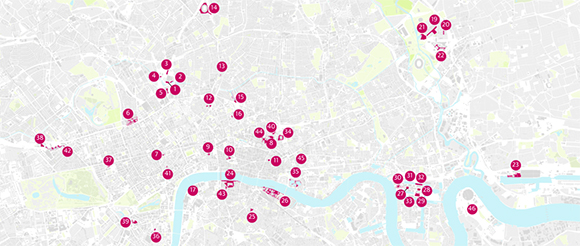
The Guarding has recently run a couple of stories on the rise of pseudo-public spaces in London and together with GiGL put together a database of such spaces in the UK and especially London. The Guardian has put together a quick guide to POPs here, listing important points such as “…appear to be public but are actually owned and controlled by developers and corporations.” or “…“Pops” – are not subject to ordinary local authority bylaws but rather governed by restrictions drawn up the landowner and usually enforced by private security companies”, noting “…public access to pseudo-public spaces remains at the discretion of landowners” and “…alter them at will. They are not obliged to make these rules public.”

Image taken from the Guardian / Map shwing the pseudo-public spaces around central London. The data has been put together in colaboration between the Guardian and GiGL and is available as open data.
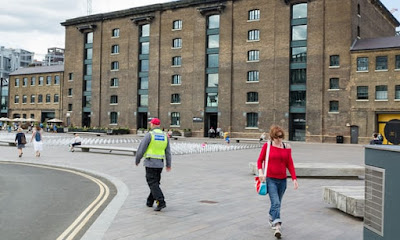

Image taken from the Guardian / View of Canary Square, Kings Cross with square and fountain and the UAL in the background.

One of the most prominent areas of these new breeds of urban spaces is the area around Kings Cross with Granary Square, Wharf Road Gardens, Gasholder Park and more. It has become over the past two or so years a very popular meeting place with new restaurants, soon to be open shopping, housing and the UAL at the centre of it. It is a very cleverly disguised pseudo-public space with the university at the centre, a very large square with a sort of public program and fountain as well as access to the Regents Canal, Kings Cross and St. Pancras station.

All of these are listed in the discussed publication as examples and many more such as St Pancras Square and Regents Place to list a few. Interestingly the author does make a reference to what he calls “political activists” presumably campaigning for public spaces. Examples listed on other news sites such as BigThink list some of the implications:

In 2011, Occupy protesters were removed from Paternoster Square, outside the London Stock Exchange, on the grounds that they were trespassing on private land owned by the Mitsubishi Estate Company.

In Pancras Square, part of King’s Cross Estate, lying down on the grass is okay, but not sleeping. One homeless man told the Guardian that as soon as he shuts his eyes, he is accosted by security guards.

Taking pictures is becoming increasingly problematic, with photographers being informed by security guards that they are on private land, and their activity is subject to prior permission – even in what looks like public space, such as Tower Place, adjacent to the Tower of London.

Public drinking is considered sufficient reason for removal from certain Pops.

A lot of data has been put together by GiGL and the Guardian on sites in London and has been published as open data here.

This implicates the publication and the approach to some extent. It raises serious questions about the use of terminology or the understanding put forward of public and space. But it does not question the intention of the author. It was put together from a practitioners point of view, probably aimed at peers. Focusing on materials and practices, but then was opened to a wider audience, as hinted in the foreword.

Image own / Spread of the pubication Landscape Observer: London, by Vladimir Guculak, 2017.

Not just, but especially as professionals in urban planning, landscape architecture, architecture, public officials and other roles involved in the planning and maintenance of public spaces, we have to be extremely careful and precise with the terminology to ensure and preserve these fundamentally important features of an open and accessible city, our open society and ultimately democracy are not undermined.

Never the less it is one of the most comprehensive collections of recent landscape architecture projects in the centre of London and as such a valuable contribution, even if vague regarding terminology and location mapping. Extensive preview available on the publisher JOVIS’ website

Image own / Cover of the pubication Landscape Observer: London, by Vladimir Guculak, 2017.

Continue reading »

Social Benefits from Public Bike Share Data

I presented at the BikePlus Future of Bike Share Conference in Manchester in late September, as part of a panel session on social benefits of public Bike Share Data. I framed my presentation in the context of open data, whereby operators or technology providers of bikeshare systems, and/or municipalities containing them, release data on the … Continue reading Social Benefits from Public Bike Share Data

Continue reading »

Chapter in Routledge Handbook of Mapping and Cartography – VGI and Beyond: From Data to Mapping

Hot on the heels of the Routledge Handbook of Environmental Justice is the Routledge Handbook of Mapping and Cartography. The handbook was edited by Alex Kent (Canterbury Christ Church University) who is currently the President of the British Cartographic Society and Editor of The Cartographic Journal; and Peter Vujakovic (also from Canterbury Christ Church University) who edited The Cartographic … Continue reading Chapter in Routledge Handbook of Mapping and Cartography – VGI and Beyond: From Data to Mapping

Continue reading »

The Progress 1000: London’s most influential people 2017 – Boffins: Science & Technology – Evening Standard


Evening Standard

The Progress 1000: London’s most influential people 2017 – Boffins: Science & Technology
Evening Standard
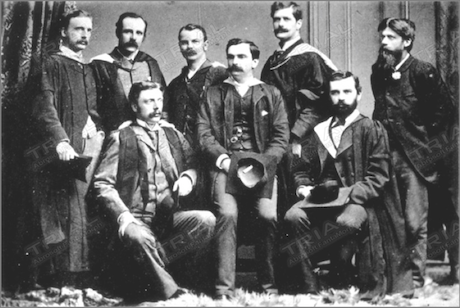
Hannah Fry (Adrian Lourie). There’s maths in everything, Fry will tell you, from how we move in crowds to finding love. A lecturer in the mathematics of cities at UCL’s Centre for Advanced Spatial Analysis, her love for maths started as a child after

Continue reading »

Caren Cooper’s Citizen Science: How Ordinary People are Changing the Face of Discovery

Today, Caren Cooper new book Citizen Science: How Ordinary People are Changing the Face of Discovery is going on sale in the UK. The book has been out in the USA for about a year, and it is a good point to review it. The library of citizen science books is growing – there are the more … Continue reading Caren Cooper’s Citizen Science: How Ordinary People are Changing the Face of Discovery

Continue reading »

London National Park City Map

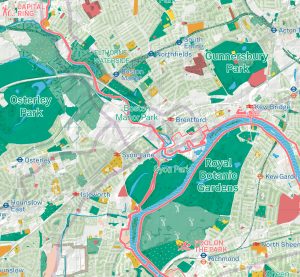
Urban Good, a new community interest company created by Charlie Peel, have this month published the first edition of their London National Park City Map. This huge, folded paper map covering the whole of London, was created through a crowdfunding campaign, and is available from Urban Good’s web store for just a payment of a […]

Continue reading »

Chapter in Routledge Handbook of Environmental Justice – Participatory GIS and community-based citizen science for environmental justice action

The Routledge Handbook of Environmental Justice has been published in mid-September. This extensive book, of 670 pages is providing an extensive overview of scholarly research on environmental justice.  The book was edited by three experts in the area – Ryan Holifield from the University of Wisconsin-Milwaukee, Jayajit Chakraborty from the University of Texas at El Paso, and Gordon Walker … Continue reading Chapter in Routledge Handbook of Environmental Justice – Participatory GIS and community-based citizen science for environmental justice action

Continue reading »

AAG2018: Innovations in Urban Analytics

Call for Papers, AAG2018: Innovations in Urban Analytics

We welcome paper submissions for our session at the Association of American Geographers Annual Meeting on 10-14 April, 2018, in New Orleans.

Session Description

New forms of data about people and cities, often termed ‘Big’, are fostering research that is disrupting many traditional fields. This is true in geography, and especially in those more technical branches of the discipline such as computational geography / geocomputation, spatial analytics and statistics, geographical data science, etc. These new forms of micro-level data have lead to new methodological approaches in order to better understand how urban systems behave. Increasingly, these approaches and data are being used to ask questions about how cities can be made more sustainable and efficient in the future.

This session will bring together the latest research in urban analytics. We are particularly interested in papers that engage with the following domains:

  • Agent-based modelling (ABM) and individual-based modelling;
  • Machine learning for urban analytics;
  • Innovations in consumer data analytics for understanding urban systems;
  • Real-time model calibration and data assimilation;
  • Spatio-temporal data analysis;
  • New data, case studies, demonstrators, and tools for the study of urban systems;
  • Complex systems analysis;
  • Geographic data mining and visualization;
  • Frequentist and Bayesian approaches to modelling cities.

Please e-mail the abstract and key words with your expression of intent to Nick Malleson (n.s.malleson@leeds.ac.uk) by 18 October, 2017 (one week before the AAG abstract deadline). Please make sure that your abstract conforms to the AAG guidelines in relation to title, word limit and key words and as specified at: http://annualmeeting.aag.org/submit_an_abstract. An abstract should be no more than 250 words that describe the presentation’s purpose, methods, and conclusions.

For those interested specifically in the interface between research and policy, they might consider submitting their paper to the session “Computation for Public Engagement in Complex Problems” (http://www.gisagents.org/2017/10/call-for-papers-computation-for-public.html).

Key Dates
  • 18 October, 2017: Abstract submission deadline. E-mail Nick Malleson by this date if you are interested in being in this session. Please submit an abstract and key words with your expression of intent.
  • 23 October, 2017: Session finalization and author notification.
  • 25 October, 2017: Final abstract submission to AAG, via the link above. All participants must register individually via this site. Upon registration you will be given a participant number (PIN). Send the PIN and a copy of your final abstract to Nick Malleson (n.s.malleson@leeds.ac.uk). Neither the organizers nor the AAG will edit the abstracts.
  • 8 November, 2017: AAG session organization deadline. Sessions submitted to AAG for approval.
  • 9-14 April, 2018: AAG Annual Meeting.
Session Organizers
Continue reading »

AAG2018: Innovations in Urban Analytics

Call for Papers, AAG2018: Innovations in Urban Analytics

We welcome paper submissions for our session at the Association of American Geographers Annual Meeting on 10-14 April, 2018, in New Orleans.

Session Description

New forms of data about people and cities, often termed ‘Big’, are fostering research that is disrupting many traditional fields. This is true in geography, and especially in those more technical branches of the discipline such as computational geography / geocomputation, spatial analytics and statistics, geographical data science, etc. These new forms of micro-level data have lead to new methodological approaches in order to better understand how urban systems behave. Increasingly, these approaches and data are being used to ask questions about how cities can be made more sustainable and efficient in the future.

This session will bring together the latest research in urban analytics. We are particularly interested in papers that engage with the following domains:

  • Agent-based modelling (ABM) and individual-based modelling;
  • Machine learning for urban analytics;
  • Innovations in consumer data analytics for understanding urban systems;
  • Real-time model calibration and data assimilation;
  • Spatio-temporal data analysis;
  • New data, case studies, demonstrators, and tools for the study of urban systems;
  • Complex systems analysis;
  • Geographic data mining and visualization;
  • Frequentist and Bayesian approaches to modelling cities.

Please e-mail the abstract and key words with your expression of intent to Nick Malleson (n.s.malleson@leeds.ac.uk) by 18 October, 2017 (one week before the AAG abstract deadline). Please make sure that your abstract conforms to the AAG guidelines in relation to title, word limit and key words and as specified at: http://annualmeeting.aag.org/submit_an_abstract. An abstract should be no more than 250 words that describe the presentation’s purpose, methods, and conclusions.

For those interested specifically in the interface between research and policy, they might consider submitting their paper to the session “Computation for Public Engagement in Complex Problems” (http://www.gisagents.org/2017/10/call-for-papers-computation-for-public.html).

Key Dates
  • 18 October, 2017: Abstract submission deadline. E-mail Nick Malleson by this date if you are interested in being in this session. Please submit an abstract and key words with your expression of intent.
  • 23 October, 2017: Session finalization and author notification.
  • 25 October, 2017: Final abstract submission to AAG, via the link above. All participants must register individually via this site. Upon registration you will be given a participant number (PIN). Send the PIN and a copy of your final abstract to Nick Malleson (n.s.malleson@leeds.ac.uk). Neither the organizers nor the AAG will edit the abstracts.
  • 8 November, 2017: AAG session organization deadline. Sessions submitted to AAG for approval.
  • 9-14 April, 2018: AAG Annual Meeting.
Session Organizers
Continue reading »

Defining principles for mobile apps and platforms development in citizen science

In December 2016, ECSA and the Natural History Museum in Berlin organised a  workshop on analysing apps, platforms, and portals for citizen science projects. Now, the report from the workshop has evolved into an open peer review paper on RIO Journal. RIO is worth noticing: is “The Research Ideas and Outcomes (RIO) journal” and what … Continue reading Defining principles for mobile apps and platforms development in citizen science

Continue reading »

More highlights from the RGS-IBG Annual Conference

PGRG Blog #3, October 2017 Postgraduate Contributions to Population Geography By Charlotte Bolton and Andreas Culora Given the previous year’s success, this postgraduate session sponsored by the Population Geography Research Group and the Postgraduate Forum returned to the conference, attracting a new cohort of postgraduate Population Geographers. The session was convened by the authors and … More More highlights from the RGS-IBG Annual Conference

Continue reading »

Call for Papers – Computation for Public Engagement in Complex Problems

Call for Papers – Computation for Public Engagement in Complex Problems: From Big Data, to Modeling, to Action 

We welcome paper submissions for our session(s) at the Association of American Geographers Annual Meeting on 9-14 April, 2018, in New Orleans.  

Session Description: In line with one of the major themes of this conference, we explore the opportunities and challenges that geo-computational tools offer to support public engagement, deliberation and decision-making to address complex problems that link human, socioeconomic and biophysical systems at a variety of different spatial and temporal scales (e.g., climate change, resource depletion, and poverty). Modelers and data scientists have shown increasing interest in the intersection between science and policy, acknowledging that, for all the computational advances achieved to support policy and decision-making, these approaches remain frustratingly foreign to the public they are meant to serve. On one hand, there is a persistent gap in the public’s understanding of and reasoning about complex systems, resulting in unintended and undesirable consequences. On the other hand, there is significant public skepticism about the knowledge generated by the modeling community and its ability to inform policy and decision-making.

We invite theoretical, methodological, and empirical papers that explore advances in geo-computational approaches, including part or all the process to address complex problems: from data collection and analysis, to the development and use of models, to supporting action with data analysis and modeling. We are interested in any work that contributes towards the overall goal of supporting public engagement and action around complex problems, including—but not limited to—the following topics:

  • epistemological perspectives; 
  • extracting behavioral rules from novel and established data sets; 
  • innovative applications of complex systems techniques, and 
  • addressing the challenge of complex systems model calibration and validation. 

Please e-mail the abstract and key words with your expression of intent to Moira Zellner (mzellner@uic.edu) by October 18, 2017 (one week before the AAG abstract deadline). Please make sure that your abstract conforms to the AAG guidelines in relation to title, word limit and key words and as specified at: http://annualmeeting.aag.org/submit_an_abstract. An abstract should be no more than 250 words that describe the presentation’s purpose, methods, and conclusions.

 Timeline summary: 

  • October 18, 2017: Abstract submission deadline. E-mail Moira Zellner (mzellner@uic.edu) by this date if you are interested in being in this session. Please submit an abstract and key words with your expression of intent. 
  • October 23, 2017: Session finalization and author notification. 
  • October 25, 2017: Final abstract submission to AAG, via the link above. All participants must register individually via this site. Upon registration you will be given a participant number (PIN). Send the PIN and a copy of your final abstract to Moira Zellner. Neither the organizers nor the AAG will edit the abstracts. 
  • November 8, 2017: AAG session organization deadline. Sessions submitted to AAG for approval. 
  • April 9-14, 2018: AAG Annual Meeting.  

Organizers:

Continue reading »

Call for Papers – Computation for Public Engagement in Complex Problems

Call for Papers – Computation for Public Engagement in Complex Problems: From Big Data, to Modeling, to Action 

We welcome paper submissions for our session(s) at the Association of American Geographers Annual Meeting on 9-14 April, 2018, in New Orleans.  

Session Description: In line with one of the major themes of this conference, we explore the opportunities and challenges that geo-computational tools offer to support public engagement, deliberation and decision-making to address complex problems that link human, socioeconomic and biophysical systems at a variety of different spatial and temporal scales (e.g., climate change, resource depletion, and poverty). Modelers and data scientists have shown increasing interest in the intersection between science and policy, acknowledging that, for all the computational advances achieved to support policy and decision-making, these approaches remain frustratingly foreign to the public they are meant to serve. On one hand, there is a persistent gap in the public’s understanding of and reasoning about complex systems, resulting in unintended and undesirable consequences. On the other hand, there is significant public skepticism about the knowledge generated by the modeling community and its ability to inform policy and decision-making.

We invite theoretical, methodological, and empirical papers that explore advances in geo-computational approaches, including part or all the process to address complex problems: from data collection and analysis, to the development and use of models, to supporting action with data analysis and modeling. We are interested in any work that contributes towards the overall goal of supporting public engagement and action around complex problems, including—but not limited to—the following topics:

  • epistemological perspectives; 
  • extracting behavioral rules from novel and established data sets; 
  • innovative applications of complex systems techniques, and 
  • addressing the challenge of complex systems model calibration and validation. 

Please e-mail the abstract and key words with your expression of intent to Moira Zellner (mzellner@uic.edu) by October 18, 2017 (one week before the AAG abstract deadline). Please make sure that your abstract conforms to the AAG guidelines in relation to title, word limit and key words and as specified at: http://annualmeeting.aag.org/submit_an_abstract. An abstract should be no more than 250 words that describe the presentation’s purpose, methods, and conclusions.

 Timeline summary: 

  • October 18, 2017: Abstract submission deadline. E-mail Moira Zellner (mzellner@uic.edu) by this date if you are interested in being in this session. Please submit an abstract and key words with your expression of intent. 
  • October 23, 2017: Session finalization and author notification. 
  • October 25, 2017: Final abstract submission to AAG, via the link above. All participants must register individually via this site. Upon registration you will be given a participant number (PIN). Send the PIN and a copy of your final abstract to Moira Zellner. Neither the organizers nor the AAG will edit the abstracts. 
  • November 8, 2017: AAG session organization deadline. Sessions submitted to AAG for approval. 
  • April 9-14, 2018: AAG Annual Meeting.  

Organizers:

Continue reading »

Local Maps

Not all maps of London need to cover the whole, 33 borough, 8 million-population metropolis. Here’s three maps that focus more on a local area: 1. Tottenham This attractive little map promotes a number of the new start-up businesses in the area – including a climbing wall, a brewery/bar, and arts centre and a concept […]

Continue reading »

Global Prospects for a Post-Car World

Earlier this year I worked on some charts and maps for a Greenpeace report authored by sustainable transport academic Robin Hickman, exploring the impacts of automobile dependence and the prospects for a post-car world. The report is online here. The much debated phenomenon of ‘peak-car’ can be observed in many countries in the global north, … Continue reading Global Prospects for a Post-Car World

Continue reading »

Chapter in ‘Understanding Spatial Media’ on VGI & Citizen Science

The book ‘Understanding Spatial Media‘ came out earlier this year. The project is the result of joint effort of the editors Rob Kitchin (NUI Maynooth, Ireland), Tracey P. Lauriault (Carleton University, Canada), and Matthew W. Wilson (University of Kentucky, USA). The book is filling the need to review and explain what happened in the part 20 years, with the increase use … Continue reading Chapter in ‘Understanding Spatial Media’ on VGI & Citizen Science

Continue reading »

Finally, a Python workflow that actually works

I do all my exploratory data work in Jupyter Notebook. It’s an amazing mix of nicely-formatted text, syntax-highlighted code and clear outputs. I love it: But it’s not the complete package. I often want to peek at the results of a calculation I’ve done, just to verify to myself that I know what I’m doing. … Continue reading “Finally, a Python workflow that actually works”

Continue reading »

Landmarks of London

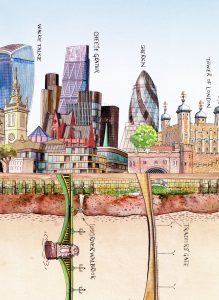
We featured Bridges of London earlier this week. However, the public realm relating to the Thames is more than the river itself and the bridges crossing it. One of London’s defining features, in recent times, as the Thames has cleaned and the spaces beside it have become less-traffic choked, is its riverside frontage. This lovely […]

Continue reading »

The Benefits of Geospatial Analysis in Marketing

Marketing is much more than creating advertisements that are outrageous and eye-catching, it’s a fine and intricate process that people spend years in school learning about. It’s important to remember that without marketing strategies, small and large businesses would have an incredibly difficult time attracting customers and in turn, receiving profits. By taking advantage of […]

The post The Benefits of Geospatial Analysis in Marketing appeared first on GeoTalisman.

Continue reading »

Agent-Based Modeling Chapter

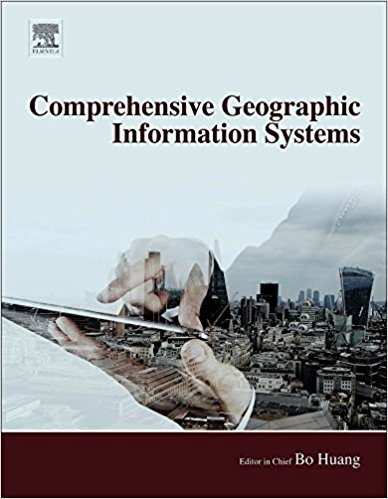
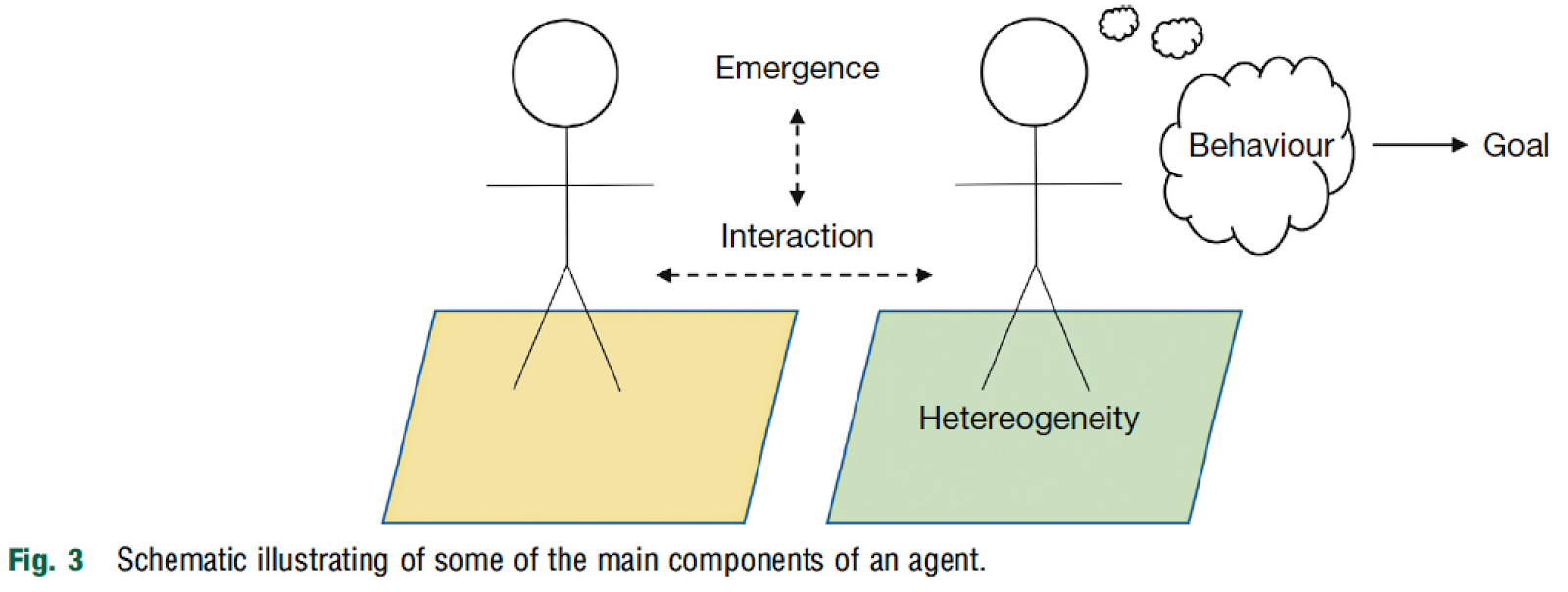
In the recently published “Comprehensive Geographic Information Systems” edited by Bo Huang, Alison Heppenstall, Nick Malleson and myself have a chapter entitled “Agent-based Modelling1. Within the chapter, we provide a overview of agent-based modeling (ABM) especially for the geographical sciences. This includes a section on how ABM emerged i.e. “The Rise of the (Automated) Machines“, along with a discussion on what constitutes an agent. This is followed with steps to building an agent-based model, including: 1) the preparation and design; 2) model implementation 3) and how one goes about evaluating a model (i.e. verification, calibration and validation and how these are particularity challenging with respect to spatial agent-based models). We then discuss how we can integrate space and GIS into agent-based models and review a number of open-source ABM toolkits (e.g. GAMA, MASON, NetLogo) before concluding with challenges and opportunities that we see ahead of us, such as adding more complex behaviors to agent-based models, and how “big data” offers new avenues for multiscale calibration and validation of agent-based models.  If you are still reading this, below you can read the abstract of the paper and find the full reference to the chapter.

Abstract:

Agent-based modeling (ABM) is a technique that allows us to explore how the interactions of heterogeneous individuals impact on the wider behavior of social/spatial systems. In this article, we introduce ABM and its utility for studying geographical systems. We discuss how agent-based models have evolved over the last 20 years and situate the discipline within the broader arena of geographical modeling. The main properties of ABM are introduced and we discuss how models are capable of capturing and incorporating human behavior. We then discuss the steps taken in building an agent-based model and the issues of verification and validation of such models. As the focus of the article is on ABM of geographical systems, we then discuss the need for integrating geographical information into models and techniques and toolkits that allow for such integration. Once the core concepts and techniques of creating agent-based models have been introduced, we then discuss a wide range of applications of agent-based models for exploring various aspects of geographical systems. We conclude the article by outlining challenges and opportunities of ABM in understanding geographical systems and human behavior.

Keywords: Agent-based modeling; Calibration; Complexity; Geographical information science; Modeling and simulation; Validation; Verification.

Full Reference

Crooks, A.T., Heppenstall, A. and Malleson, N. (2018), Agent-based Modelling, in Huang, B. (ed), Comprehensive Geographic Information Systems, Elsevier, Oxford, England. Volume 1, pp. 218-243 DOI: https://doi.org/10.1016/B978-0-12-409548-9.09704-9. (pdf)

1. [Readers of this blog might of expected the chapter would be about Agent-based Modeling, but its still worth a read!]

Continue reading »

Agent-Based Modeling Chapter

In the recently published “Comprehensive Geographic Information Systems” edited by Bo Huang, Alison Heppenstall, Nick Malleson and myself have a chapter entitled “Agent-based Modelling1. Within the chapter, we provide a overview of agent-based modeling (ABM) especially for the geographical sciences. This includes a section on how ABM emerged i.e. “The Rise of the (Automated) Machines“, along with a discussion on what constitutes an agent. This is followed with steps to building an agent-based model, including: 1) the preparation and design; 2) model implementation 3) and how one goes about evaluating a model (i.e. verification, calibration and validation and how these are particularity challenging with respect to spatial agent-based models). We then discuss how we can integrate space and GIS into agent-based models and review a number of open-source ABM toolkits (e.g. GAMA, MASON, NetLogo) before concluding with challenges and opportunities that we see ahead of us, such as adding more complex behaviors to agent-based models, and how “big data” offers new avenues for multiscale calibration and validation of agent-based models.  If you are still reading this, below you can read the abstract of the paper and find the full reference to the chapter.

Abstract:

Agent-based modeling (ABM) is a technique that allows us to explore how the interactions of heterogeneous individuals impact on the wider behavior of social/spatial systems. In this article, we introduce ABM and its utility for studying geographical systems. We discuss how agent-based models have evolved over the last 20 years and situate the discipline within the broader arena of geographical modeling. The main properties of ABM are introduced and we discuss how models are capable of capturing and incorporating human behavior. We then discuss the steps taken in building an agent-based model and the issues of verification and validation of such models. As the focus of the article is on ABM of geographical systems, we then discuss the need for integrating geographical information into models and techniques and toolkits that allow for such integration. Once the core concepts and techniques of creating agent-based models have been introduced, we then discuss a wide range of applications of agent-based models for exploring various aspects of geographical systems. We conclude the article by outlining challenges and opportunities of ABM in understanding geographical systems and human behavior.

Keywords: Agent-based modeling; Calibration; Complexity; Geographical information science; Modeling and simulation; Validation; Verification.

Full Reference

Crooks, A.T., Heppenstall, A. and Malleson, N. (2018), Agent-based Modelling, in Huang, B. (ed), Comprehensive Geographic Information Systems, Elsevier, Oxford, England. Volume 1, pp. 218-243 DOI: https://doi.org/10.1016/B978-0-12-409548-9.09704-9. (pdf)

1. [Readers of this blog might of expected the chapter would be about Agent-based Modeling, but its still worth a read!]

Continue reading »

Bridges of London

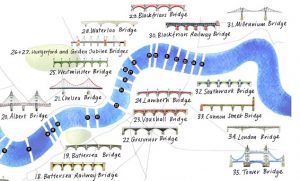
The River Thames is London’s defining geographical feature and its inclusion is almost mandatory on any map attempting to cover the whole of the capital. Bridges are most Londoners’ visible contact with the river, with over 30 spanning the river in London, including elevated crossing by the so-called “Underground”. As such, illustrated maps of the […]

Continue reading »

Changing departments – the pros and cons of being away from home discipline(s)

Last weekend, I updated my Linkedin page to indicate that I’ve now completed the move between departments at UCL – from the Department of Civil, Environmental, and Geomatic Engineering to the Department of Geography. It’s not just me – the Extreme Citizen Science group will be now based at the Department of Geography. With this move, … Continue reading Changing departments – the pros and cons of being away from home discipline(s)

Continue reading »

Highlights from RGS-IBG

PGRG Blog #3, September 2017 Negotiating Brexit: Migrant spatialities and identities in a changing Europe By Kate Botterill and David McCollum Three sessions on ‘Negotiating Brexit’ at the 2017 RGS-IBG Annual Conference showcased emerging research on the impacts of Brexit on EU and non-EU nationals in the UK, British nationals in Europe and on established … More Highlights from RGS-IBG

Continue reading »

New paper – Exploring Engagement Characteristics and Behaviours of Environmental Volunteers

A new paper that is based on the PhD work of Valentine Seymour is out. Valentine has been researching the patterns of volunteering in environmental projects at the organisation The Conservation Volunteers. In the paper, we draw parallels between the activities of environmental volunteers and citizen science participants. The analysis demonstrates that the patterns of … Continue reading New paper – Exploring Engagement Characteristics and Behaviours of Environmental Volunteers

Continue reading »

TfL seeking permanent customer wi-fi data collection on the Tube – Rail Technology Magazine


Rail Technology Magazine

TfL seeking permanent customer wi-fi data collection on the Tube
Rail Technology Magazine
Dr Hannah Fry, from the Centre for Advanced Spatial Analysis at University College London, added that wi-fi data offers a “completely new way” of viewing what’s happening underground, exposing the network’s pinch points and helping understand how and …
Wi-Fi use + big data analytics = better passenger journeys in London?SmartRail World (press release)

all 8 news articles »

Continue reading »

GDP may partly be “based on randomly generated numbers”

GDP is easy to describe. It’s one of the reasons it is so popular as a measure of what a country “does” economically. You just add up everything that’s produced in a given year, and subtract all the stuff that went into making it. What’s left is the genuinely “new” stuff the economy produced that … Continue reading “GDP may partly be “based on randomly generated numbers””

Continue reading »
1 51 52 53 54 55 175